Robot learns to walk like a stick insect using AI
One day in the near future, you could be left incapacitated in the middle of an earthquake-ravaged landscape where wheeled vehicles won’t be able to reach you. Or in the very distant future, after engineers have solved thousands of problems associated with saving interplanetary astronauts from radiation, your great-granddaughter could be incapacitated in the middle of an earthquake-ravaged landscape where wheeled vehicles cannot reach her.
So who will save you (or her)?
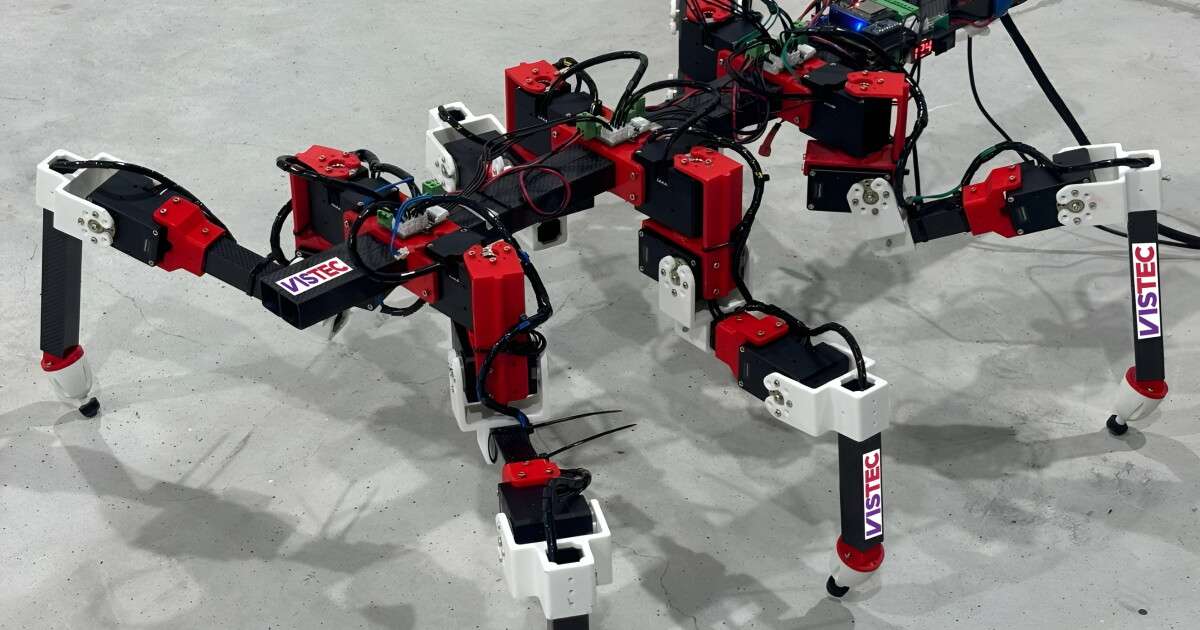
If it’s up to an international group of researchers led by Japan’s Tohoku University and Thailand’s Vidyasirimedhi Institute of Science and Technology (VISTEC), it could simply be a massive insectobot, one that learned to walk on different surfaces through AI-powered biophilic copies of stick insect locomotion.
“It’s surprising that a few steps from a single stick insect,” says Dai Owaki, an associate professor at Tohoku University, “were enough to find a principle that works in a machine five times its size.”
in your Bioinspiration and biomimetics In the paper, Owaki’s team explains that while insects have tiny brains and nerve networks compared to humans, they are still capable of remarkably complex movements and dynamic adaptation. But until now, entomologists and other professionals have been unable to identify and computationally model the exact principles of insect leg coordination.
The result has been imperfect biophilic (or insectomimetic) coordination rules, parameters, and reward functions that hinder flexibility and are so specific that they prevent transfer from one robot body type to another.
From insect behavior to transferable robotic locomotion
As Owaki explains, his team departed from traditional approaches to teaching robots to move. “We never told the robot how to walk. We asked what the insect was trying to achieve and let the robot pursue the same thing on its own.”
Because he and his colleagues were working to create a teaching model that didn’t rely on providing the AI with explicit instructions on how to walk, they used adversarial inverse reinforcement learning, that is, an imitative approach that identifies the “reward” of safe foot placement while adapting to changing conditions and identifying new rewards.
The result was so successful that the hexadic training robot only needed a brief exposure to a walking stick insect that navigated flat areas to “learn” to walk on various terrains (and in the future, other highly coordinated creatures could be examples). Surprisingly, he learned to do it in less than an hour.
Additionally, the reward network was so robust that it could serve robots with a variety of body types without requiring complicated customization. With additional memory, researchers say, robots using this learning method may someday be able to help in disaster zones where smooth, uniform roads may not be accessible or even exist. And even if these robots lose limbs in the chaos, their learning system can help them walk anyway.
If you’re fascinated by the emerging world of walking robots, you’re living in the best time (so far) in human history, and you can enjoy Russian ostrich robots, the stiff-legged bipedal Mugatu robot that looks nothing like Mugatu, a huge hexapedal kaiju-mech, a robot dragon, and, of course, kung fu robots designed by people who never bothered to listen to Sarah Connor.
Source: Tohoku University













Post Comment