VR chair offers a new way to access virtual worlds without headphones
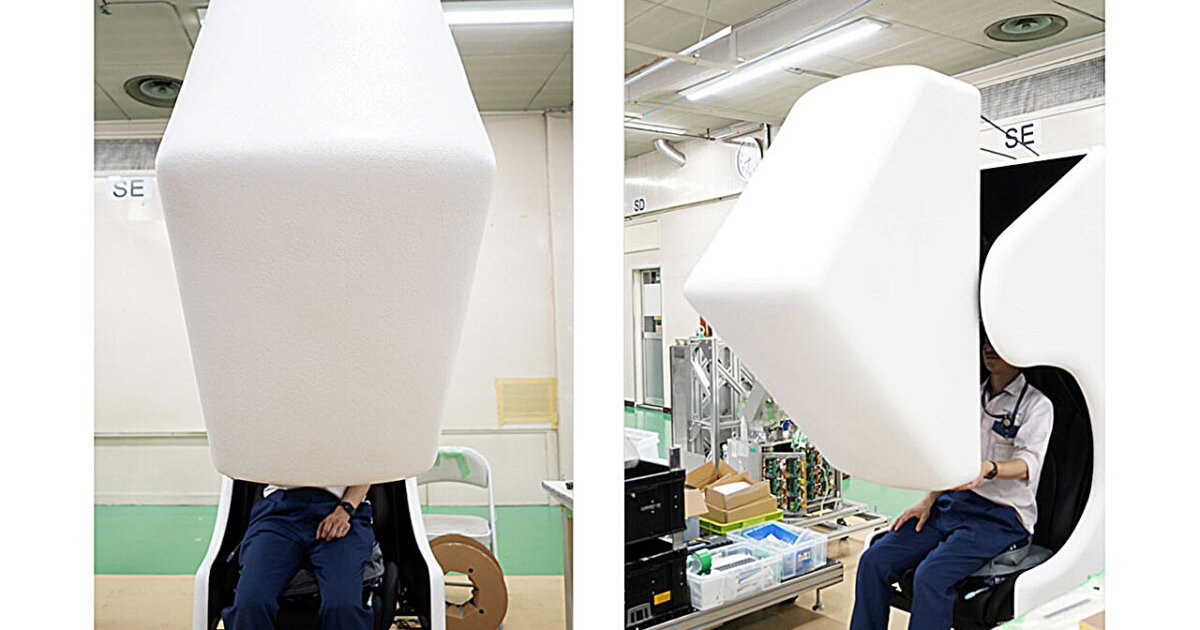
Virtual reality can take you anywhere, but if you put on a headset for long enough, your neck pain will bring you back to real reality. A researcher at Kyushu University wants to change that and his idea is a chair that offers a new way of experiencing virtual worlds.
So far, immersive virtual reality mainly comes in two versions: projection rooms and headsets, and each solves the problem of the other. Screening rooms, like domes, surround you with screens and don’t ask you to use additional equipment, but the depth of the scene remains tied to the size of the room. Headphones avoid this by placing an image at any distance, which is why they give the sensation of entering a scene, but do so by tying weight to the head.
The new chair is presented as a third way. It combines the stable environment of a projection room with the personal point of view of a headset. According to researchers, it surpasses domes in image depth and headphones in comfort and ease of access.
The project began with a complaint from a student. “Some days you’re more in virtual reality than outside of it,” recalls Shogo Fukushima, associate professor at Kyushu University’s School of Information Sciences and Electrical Engineering and author of the paper, published in SIGGRAPH Emerging Technologies ’26. “He even tried to sleep there, but the headphones made it difficult for him to feel comfortable.”
Today’s virtual reality equipment is designed for short sessions, not for someone who practically lives in it, like this student. Wider views, sharper resolution and more processing power add hardware and, with it, weight and pressure on the head and neck. Instead of reducing that weight, the Fukushima lab asked if it was necessary to use something.
Sitting in the chair, you get a wide, movie-like view from a seat no larger than an armchair. A headset fakes depth by showing each eye a slightly different image through lenses placed close to the face. The Kyushu team achieves the same effect with a micromirror array, a panel of many tiny mirrors that sends a different image to each eye.
Mountless Aerial HMDs: Non-Wearable VR Experience at SIGGRAPH 2026
The design uses aerial imaging optics, a technique that causes images to float in space rather than remain on a screen. It offers the user a wide, cinema-like 3D view from a compact seat, without headphones.
The optics themselves are not new. According to the newspaper, mirror elements of this type have been in development since approximately 2006. The step forward is a functional system in which one can sit and look around. The optical module is mounted on a chair and a built-in gyroscope, a sensor that detects rotation, follows your turns in real time. Rotate your body and the 3D view rotates with you, no calibration required.
Fukushima raises another possible benefit, one that might appeal to those who get motion sickness easily, including this writer. “Our system also has the potential to reduce VR illnesses in the future,” he says. “Without a headset limiting the design, larger optical components and moving mechanisms can be incorporated more freely.” These changes could alleviate the mismatch between what the eyes see and what the body feels.
Giving up headphones comes at a cost. The mirror plate absorbs some of the light, which means a very bright screen, and its size greatly limits the width of vision. The document itself acknowledges that the field of view is limited, and its comparison table rates both field of view and portability as only “conditionally supported.”
The study also describes only rotation, with the view rotating like the chair does, and does not claim that you can look 360 degrees in all directions. What’s not clear is whether a narrower view takes away from the immersion that makes virtual reality so appealing. It does not provide field of view figures or user tests that measure the feeling of immersion.
To expand the vision, he proposes placing flat mirrors above, below and on both sides of the plate, which in theory could expand the effective screen up to six times. The document says that a prototype demonstration shows that the view can be magnified in this way, but no measurements are reported and the only way to know if the chair convinces is to sit in it.
The team is now looking for industry partners to work on uses such as in-car workspaces, interactive museum exhibits, remote-controlled construction machinery and disaster response robots. Down the road, Fukushima hopes to build something like Doraemon’s “Anywhere Door” (a magical door from the Japanese manga and anime series that opens to anywhere), allowing two people to share a virtual scene.
Source: Kyushu University











Post Comment