MIT drone’s brain uses obstacle prediction to avoid collisions
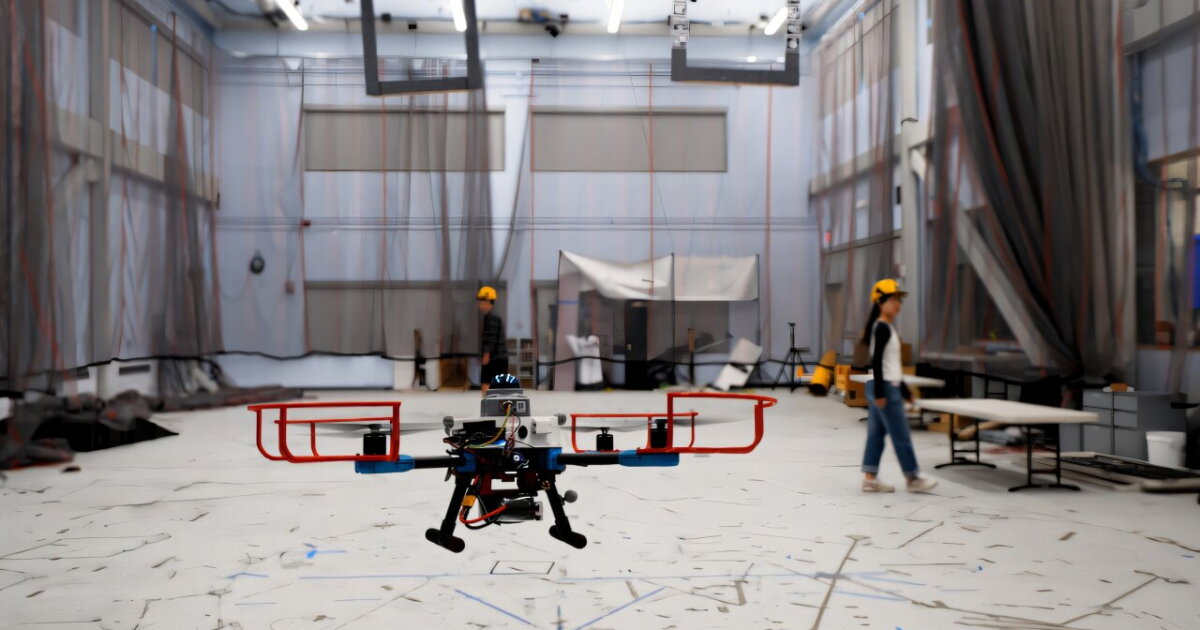
Disaster zones are terrible places to follow a pre-planned route. Maps can be incomplete, debris can move, and the next danger can come from any direction at any time. MIT’s new navigation system builds a safe flight corridor around potential future hazard movements, helping a drone avoid collisions even without a prior map.
Called SANDO, the system plans routes through unknown environments with a mathematical guarantee of avoiding collisions, as long as its operating assumptions are met. You don’t need to know where obstacles are going, just a reliable upper limit on how fast they can move. “The only thing the planner needs to know is the maximum speed the obstacles could reach,” says Kota Kondo, who recently earned his doctorate in aeronautics and astronautics at MIT.
Kondo’s interest in disaster response robotics dates back to the Fukushima nuclear disaster in Japan. “I remember seeing the response at the nuclear site and thinking: why do humans have to get so close? Is there another way to handle this situation?” says, lead author of the study published in IEEE Transactions on Robotics. “That really stuck with me.”
Helping robots avoid the unexpected
Flight planners use a drone’s cameras and sensors to plot a route to their destination. According to MIT, many existing systems offer formal safety guarantees only when obstacles are stationary or known in advance. Others avoid moving objects without mathematically guaranteeing that a collision will not occur.
SANDO’s approach is to plan around possibilities rather than betting on a single prediction. The system detects, groups and tracks moving obstacles, then surrounds each one with a virtual sphere that represents how far it could travel in any direction during a given time. The further ahead the planner looks, the larger that sphere becomes.
Think of a distracted pedestrian. Instead of assuming they will continue walking in a straight line, the planner makes room for each position they can reach within their speed limit.
Around these expanding buffers, SANDO builds a safety corridor, a chain of connected, obstacle-free regions of three-dimensional space. Because the corridor changes over time, it takes into account hazards that could get in the drone’s path after calculating the route for the first time. “But by taking this time component into account, we can now ensure security in the future,” Kondo says.
Melanie Gonick, MIT
A separate heat map planner pinpoints areas full of obstacles and directs the drone toward less congested routes. Within the safety corridor, SANDO calculates the fastest trajectory, continuously updating both the corridor and the flight path via the on-board computer.
According to MIT, in simulations, SANDO reached its destination faster than several more modern comparison systems while avoiding collisions in all tested environments. He also avoided all moving obstacles in 12 flights with a real drone.
Those results support the approach, but 12 successful flights are not proof of preparedness for every disaster scenario. The mathematical guarantee also depends on the speed limit of the obstacle being valid. An object moving faster than that limit would fall outside the warranty described by the researchers.
Next steps could include reducing the computational workload and connecting SANDO to machine learning systems that accept plain language instructions. In the accompanying video (above), Kondo also describes the ambition to coordinate multiple drones, share observations and divide search tasks.
The goal is more than keeping a plane intact. If it proves reliable beyond the lab, SANDO could help rescuers search for dangerous places faster without entering them first, and could also guide drones through collapsed buildings, mine tunnels or crowded neighborhoods.
Source: MIT












Post Comment