The portable touch screen makes its way into the fabric of your garment
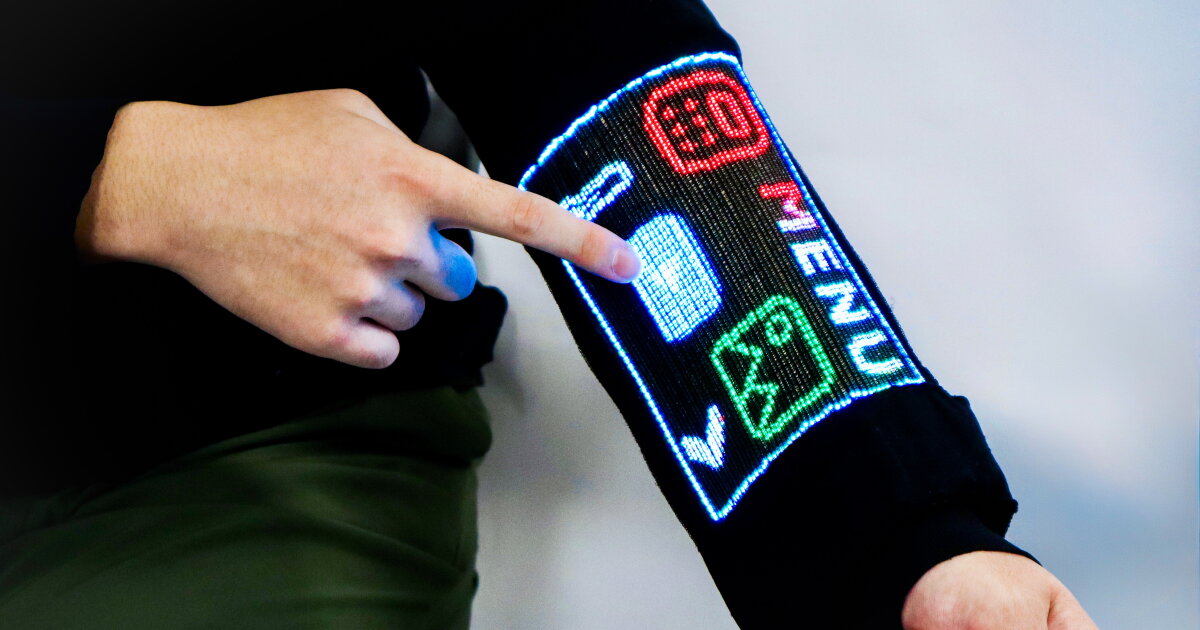
Screens have become indispensable in most of our daily lives. We have them on phones, billboards, small handheld devices, coffee makers, bathrooms and everywhere. Scientists have now discovered a way to integrate them into the very fabric of clothing.
Researchers at the National University of Singapore (NUS) have found a way to turn ordinary-looking fabrics into an interactive display.
We’re not talking about a screen embedded in a T-shirt; the fabric itself It’s the screen. It can play videos, show notifications, measure your body temperature, and respond when you touch it! The enabling technology is a special pressure-sensitive electronic fiber containing miniature LED chips, electrical connections and a touch-sensitive layer. Each fiber is approximately 1 mm thick and 10 meters (32.8 ft) long.
National University of Singapore
For the demonstration, the researchers incorporated 54 of these fibers into the forearm of a sleeve. Each fiber contains 96 LEDs, resulting in a 96 × 54 pixel display with a screen size of 168 × 105 mm; a refresh rate of 30 frames per second; and 8-bit color depth. Of course, it’s a fairly low-resolution display by modern standards, but it can display recognizable images, animations, and simple graphical interfaces. Plus, it’s a shirt sleeve!
Beyond display fibers, the scientists also embedded a microphone, speaker, and various sensors into flexible fibers in the garments. The project is detailed in the magazine, Nature.
So how does it actually work? The first part of the trick is the electronic fibers themselves, which researchers call digital pixel fibers. Each fiber is a long, flexible plastic strand containing a row of miniature LED chips, small electrical wires, and a touch-sensitive layer. Each LED acts as an individual pixel that can light up in different colors, while the electrical wires supply power and carry instructions that tell the LEDs what to display.
National University of Singapore
Getting all these electronic components into something as thin and flexible as a thread was no easy task.
The researchers started by placing thousands of miniature RGB LED chips in a straight line and then ran several incredibly thin insulated copper wires along them. Using a programmable laser, they carefully removed the insulation at specific points where the wires needed to connect to the LEDs. They then applied solder and heated the assembly, allowing the molten metal to bond only to the exposed copper sections. This method allowed them to connect more than 5,000 electronic chips through more than 20,000 electrical connections.
Once the LEDs and their electrical connections were installed, the researchers used a process called thermal drawing to convert the assembly into a fiber. This involved heating a larger polymer structure until it softened, then stretching it into a thinner, elongated shape while continuously powering the interconnected LED strip. The process encased the electronics in a transparent, flexible polymer and incorporated conductive layers beneath the LEDs for touch sensing.
Each terminated fiber essentially functions as a long, narrow digital display. LEDs contain red, green and blue light-emitting elements whose brightness can be adjusted to produce different colors. A controller sends digital instructions along the copper wires, telling each LED what color to produce and how brightly to shine. Each LED receives its instructions and passes the remaining data to the next, allowing the entire row to display different colors and patterns simultaneously.
Once the individual fibers were working, the next step was to assemble them into a real touch screen. For their prototype, the researchers incorporated 54 electronic fibers (each with 96 individually controllable LEDs) into the forearm section of a garment’s sleeve, turning it into a functional two-dimensional display.
Introducing the Apparel GUI!
Beyond the touch screen itself, the researchers also incorporated several specialized electronic fibers into the garment, made with the same technique as the screen fibers.
These include a microphone and speaker for voice commands and audio playback; motion sensors to detect movement and orientation; a magnetometer for compass functionality; a temperature sensor to monitor body temperature; and an ambient light sensor to automatically adjust screen brightness. Together, these components allow the case to perform several functions associated with early smartphones, including playing videos with sound, responding to voice commands, automatically rotating its screen, and displaying the user’s body temperature.
Now there are flexible screens, electronic textiles and smart clothing. However, most approaches attach electronics to the fabric or integrate relatively simple lighting and sensing functions. However, a programmable, touch-sensitive graphical user interface built from electronic fibers that are part of the garment itself is a novelty.
What’s more, despite all the electronics involved, the researchers showed that the e-fabric could withstand 50 machine washes and 1,000 bending cycles without substantial deterioration in its display or touch performance. The manufacturing architecture, which integrates more than 5,000 chips with more than 20,000 electrical connections while maintaining the flexibility and breathability of the fabric, is also a significant achievement.
National University of Singapore
Potential applications include smart clothing that displays notifications, navigation instructions and other information without users having to reach for their phones. In healthcare, garments could continuously monitor vital signs such as body temperature and heart rate, allowing users to view and interact with their health data directly on the clothing.
Athletes could use similar garments to track their performance, while workers in industrial settings could receive safety alerts and operating instructions on their sleeves. The researchers also plan to integrate artificial intelligence in future versions, which could allow clothing to respond intelligently to the wearer and their environment.
On the other hand, a 1 mm thick thread is relatively thick. The screen resolution is also quite low by modern standards.
Researchers are now working to improve display resolution by developing smaller electronics and thinner fibers, while integrating more advanced sensors and artificial intelligence capabilities into the device. The ultimate goal is to combine visualization, haptic sensing and intelligent processing into a single textile platform, paving the way for clothing that can monitor its wearer, understand its environment and provide information or assistance when needed.
Source: National University of Singapore














Post Comment