Northern Gannet Image Wins Bird Photographer of the Year Award
Fellow bird nerds, it’s time to reveal the winners of one of the biggest nature photography contests on the calendar. Over 24,000 images were submitted to the Bird Photographer of the Year awards last year, but in the end only a few were selected from the competition categories.
This year, a striking image of a northern gannet (Morus bassanus) in Scottish waters has earned the British snapper Henley Spiers the grand prize. This is also good news for the species, which has been rocked by outbreaks of avian influenza in North American nesting sites in recent years.
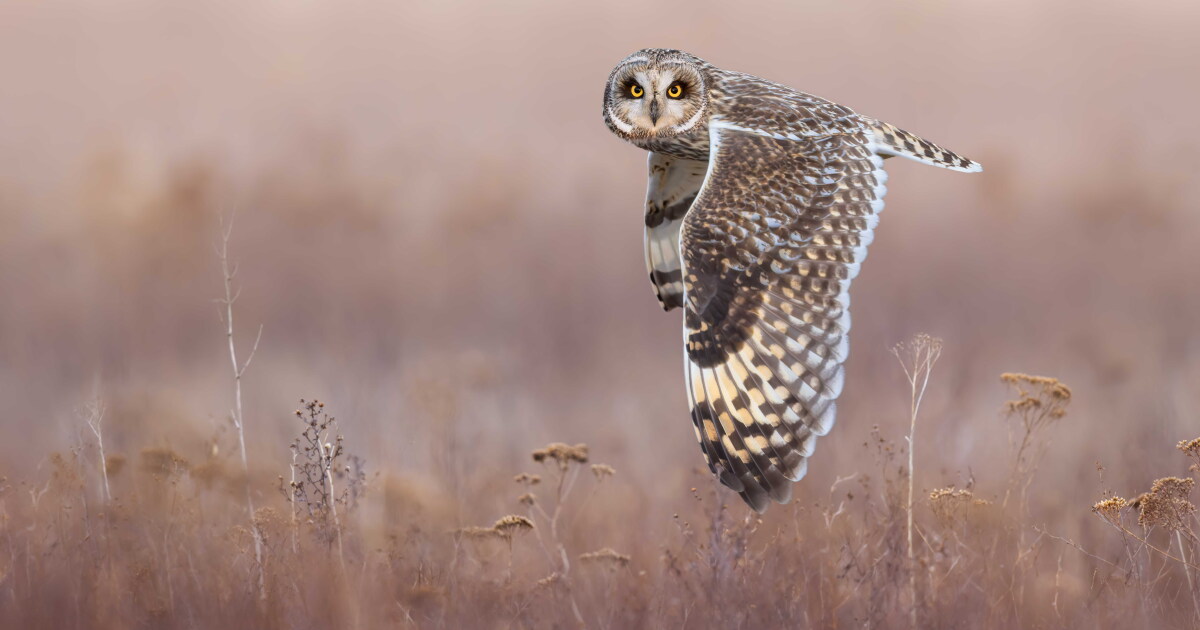
Our cover image isn’t the only owl starring this year either. Swedish photographer Ivan Sjögren was caught in the act, spying on a long-eared owl (asio flammeus) in Canada. It awarded Sjögren the Gold Award in the Birds in Flight category.
“It was a magical evening, with five owls eating around me as dusk fell,” says the photographer. “I witnessed both owl fights and, later, wing-flapping displays. I took this photo by positioning myself strategically, crouching in the grass after anticipating the owls’ hunting routes. I was lucky that the owl turned its head to look at me as it silently passed by.”
We’ll share some snaps here, with plenty more of the winners and runners-up in our gallery. And if you want more, check out our previous coverage.
Overall Gold Winner for Bird Photographer and Birds in the Environment: “Sunball Rocket” by Henley Spiers (UK)
Henley Spiers/Bird Photographer of the Year
“The beautiful northern gannets lead a dualistic existence,” Spiers notes. “In the nest, their newborn is carefully raised, and the pair’s bond is reinforced as they point their sharp beaks at the sky while tenderly caressing their white necks. In flight, hunting mode takes over, and their piercing yellow eyes, rimmed with blue circles, scan the sea in search of prey. Their long wingspan and streamlined bodies make flying seem effortless, gliding with just the occasional pulse of their wings.”
When they see a fish, they catch it and can travel through the water faster than an Olympic diver.
“These seabirds are especially adapted for impact: muscles along the neck lock their vertebrae and air sacs in the face and chest act as airbags,” he continues. “Even their nostrils have evolved for this aquatic existence, located internally to prevent water entry during fishing dives.”
Nikon Z 8 with Nikon 8-15mm f/3.5-4.5E lens. 15mm; 1/200; f/11; ISO500.
Silver Winner for Best Portrait: “Sunset Puffin” by Volker Widmann (Germany)
Volker Widmann/Bird Photographer of the Year
Volker Widmann captured the photogenic Atlantic puffin (Fratercula arctica) on Skomer Island, United Kingdom.
“I spent several days on Skomer photographing Atlantic puffins in the early morning and late afternoon, when the tourists had left the island and you had the birds almost to yourself,” says Widmann. “This afternoon I waited at the puffin colony until the sun set and photographed this bird against the reflections of the ocean.”
Canon EOS R5 with Canon EF 500mm f/4L IS II USM lens. 500mm; 1/400; f/4; ISO100.
Urban Birds Silver Winner: “Deception’s Hope” by Romain Barats (France)
Romain Barats/Bird Photographer of the Year
Romain Barats took this fantastic image of a trio of gentoo penguins (Pygoscelis papua) in the middle of their catastrophic annual molt on Deception Island, Antarctica. During this phase, where they lose their entire coat of feathers as a new set progresses, these active and playful penguins cannot swim and are known to be particularly cranky during these few weeks.
“This photograph was taken on Deception Island, near the Antarctic Peninsula,” says Barats. “Many disasters occur on Deception Island. Home to a sea lion trade that nearly led to the extinction of seals, a whaling station, and then many volcanic eruptions that led to the destruction of scientific stations, this island appears to be cursed.
“But since then, nature has taken back its rights, like these gentoo penguins posing like guards in front of a rusty whale blubber warehouse.”
Canon EOS R5 Mark II with Canon RF 100-300mm f/2.8 L IS USM lens and 1.4x teleconverter. 237mm; 1/200; f/14; ISO 2000.
Birds in the Environment Silver Winner: “Majesty” by Åsmund Keilen (Norway)
Åsmund Keilen/Bird Photographer of the Year
Norwegian photographer Åsmund Keilen captured this amazing silhouette of a golden eagle in the moonlight (Aquila chrysaetosina) in Urke, Ørsta.
“A majestic golden eagle floats in dark silhouette over the face of the moon, its outstretched wings cutting a powerful shape through the silvery light,” according to the photographer. “Below, the winter-clad peaks rise in silent stillness, their icy crests superimposed by multiple in-camera exposures to shape the visual expression I imagined.
“The composition feels both graphic and atmospheric: a meeting of shadow and brightness, strength and silence. Suspended against the luminous moon, the eagle becomes a timeless presence in the cold, breathless vastness of the alpine night.”
Canon EOS 5DS R with Canon EF 100-400mm f/4.5-5.6L IS II USM lens. 360mm; 1/8,000; f/5.6; ISO 400.
Bird Behavior Gold Winner: “I’ll Keep Everyone Dry” by Donald Chin (Australia)
Donald Chin/Bird Photographer of the Year
Donald Chin took this photo of one of my favorite birds, the tawny frogmouth (Podargus strigoides), with a trio huddled in the kind of trees they so cleverly camouflage themselves with.
“The rain goes through the forest,” says Chin. “Camouflaged against bark and shadow, a budding tawny frogmouth spreads its wings in what appears to cover its other brethren from the drops of water. Stillness is its field, patience its inheritance. In the silence between the falling drops, resilience becomes a form of silent strength.”
These carnivorous, nocturnal birds are often confused with owls, but they are not at all. They are most closely related to nightjars, which are also just as difficult to spot at night as these Australian beauties.
Sony a9 III with Sony FE 600mm f/4 GM OSS lens and 1.4x teleconverter. 840mm; 1/200; f/5.6; ISO 4,000.
Young Bird Photographer and Gold Winner (15-17 years): “Moonlit Night” by Parham Pourahmad (USA)
Parham Pourahmad/Bird Photographer of the Year
Young American snapper Parham Pourahmad won not only an age category but also the Young Bird Photographer of the Year award for this otherworldly image of a great horned owl (Virginian bubo).
“I found a pair of great horned owls nesting in a park next to my house,” says Pourahmad. “I went out at dusk, hoping to capture a strong portrait of the owls. However, my goal changed when I saw the full moon rising on the horizon. One of the owls flew up to a pine tree, and I quickly positioned myself to frame it against the moon.”
Forget the Bat-Signal, give us the Owl Signal.
Canon EOS Rebel T5i with Sigma 150-600mm f/5-6.3 DG OS HSM Contemporary lens. 275mm; 1/500; f/5.6; ISO 6,400.
Source: Bird Photographer of the Year.








Post Comment