Atari’s 800XL returns with keyboard, cartridges and BASIC
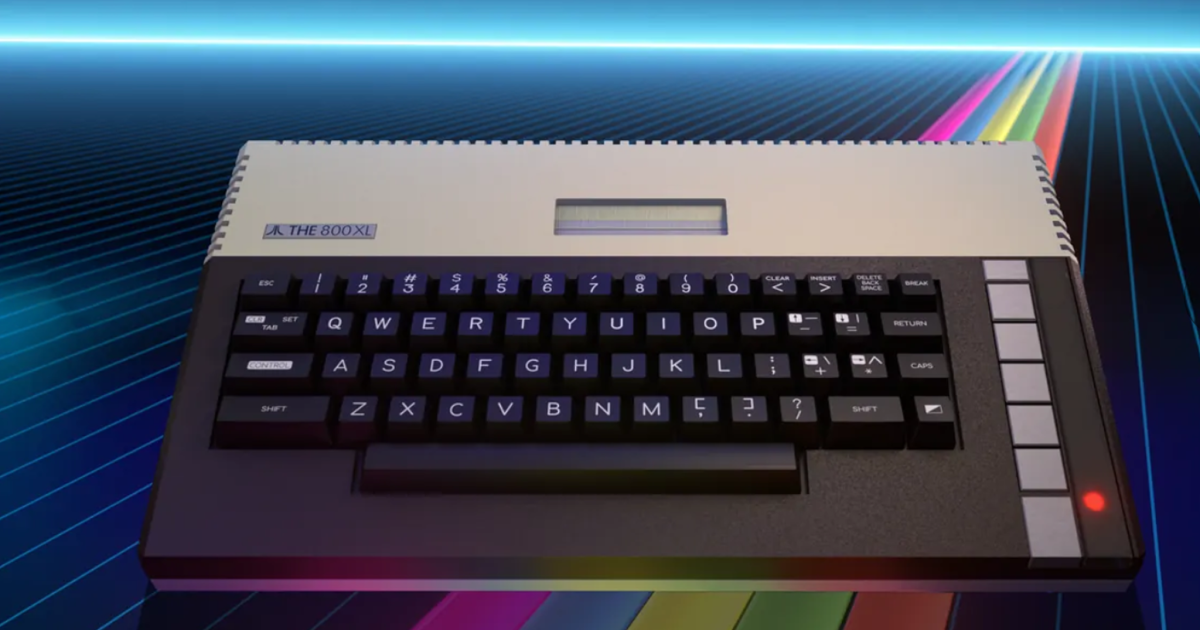
The 1983 Atari home computer returns with modern connections, 25 classic games, and a working cartridge slot. But the most interesting feature might be the opportunity to rewrite your own software.
I remember coming home from school in the ’80s, sitting in front of my small cream-colored black-and-white television with its rotating tuning dial and metal clothes-hanging antenna, and painstakingly typing out BASIC programs on my Sinclair ZX81. I wasn’t ten years old yet and I didn’t really understand what I was doing, I just wanted to play. There was also no one to ask when things went wrong, which they inevitably did.
For all the talk about those first home computers that taught a generation to program, my experience was quite different. I never became a programmer. But they did introduce me to the idea that a computer could do something I had helped create, even if I didn’t quite understand how.
Maybe that’s why I’m more interested in the inclusion of Atari BASIC than another collection of retro games. THE 800XL, as the new machine is officially called, promises to recreate not only the look of the 1983 Atari computer, but also some of the experience of owning one.
Designed by Retro Games Ltd. and manufactured and distributed by PLAION REPLAI under license from Atari, the game is available for pre-order for $219.99 (AU$349.99, £199.99 or €219.99), with shipping scheduled to begin on April 23, 2027.
More than a game console
The original Atari 800XL arrived in 1983 with 64 KB of memory, a full-size keyboard, and dedicated sound and graphics chips. Like many home computers of its generation, it occupied an interesting middle ground between a gaming machine and a tool for learning computer science.
The new version retains the familiar low-profile layout, complete with a 57-key mechanical keyboard and a working cartridge slot, but replaces the hassle of connecting older hardware to modern displays with an HDMI output.
It supports 50Hz PAL and 60Hz NTSC output, with 4:3 and pixel-perfect display options, along with optional CRT filters for those who prefer their ’80s graphics with a little less digital perfection.
Four USB-A ports house controllers and USB storage, while a USB-C connection supplies power. An HDMI cable and USB-C power cable are included, although as seems to be the trend, you’ll need to provide a suitable power adapter.
Atari has also included an updated version of its classic joystick, called THECXSTICK, which retains the familiar look but adds eight buttons for additional functions. The pad of my thumb grimaces just by looking at it.
Atari
Twenty-five games and a little programming.
THE 800XL includes 25 built-in games, featuring arcade classics such as Asteroids, Centipede, Missile Command, BattleZone and Berzerk alongside home computer favorites including Boulder Dash, MULE and Miner 2049er.
There are even two hidden games, Castle Crisis and Super Breakout, that can be unlocked by plugging in an analog controller.
The owners of the original Atari software are not completely forgotten either. The cartridge slot supports most cartridges from the Atari 400, 800, XL and XE families, while the USB storage can be used to load cartridge, disc and cassette images. Atari also announces support for software developed for its 5200 game console.
Four save slots per game and a rewind function present some conveniences that gamers in 1983 could only have dreamed of.
However, the included game selection is the same as that supplied with the previous THE400 Mini, which already supports loading Atari software over USB. If all you want to do is play those games on a modern TV, the new machine doesn’t offer a substantially different software library.
The real difference is its physical hardware, particularly the keyboard and cartridge slot.
Switch to classic mode and THE 800XL becomes a programmable home computer, with Atari BASIC available to write, save and run your own programs. BASIC was the language that introduced countless home computer owners to the idea that computers could be commanded to do more than just run software that someone else had written.
Of course, no one needs an 8-bit computer to learn to program in 2026. A modern laptop can do that and more, and there are countless free environments for learning to code. But there’s something appealing about a machine where the computer, keyboard, and programming environment form a single, simple package.
Recreation or imitation?
One question remains: how faithfully does THE 800XL recreate the original machine beneath its familiar exterior?
Retro Games Ltd. has yet to provide many details about the internal hardware architecture. That leaves open the distinction between recreating the behavior of an Atari 800XL using modern software and reproducing the original hardware more directly.
If the games work correctly, the cartridges work, and BASIC behaves as expected, the experience could be compelling regardless of what electronic devices are doing the work.
For enthusiasts, however, compatibility and accuracy are likely to be more important. Atari says the cartridge slot supports most original cartridges, leaving some uncertainty as to what exactly will work.
Atari
THE 800XL also enters the retrocomputing market where family machines are receiving more and more modern conveniences, from the ZX Spectrum Next to Retro Games Ltd.’s own THE400 Mini and its recreation of the full-size Commodore 64.
What makes this particular resurgence interesting is not simply that another beige computer has returned from the dead. Atari offers a machine designed to do something increasingly unusual: invite its owner to experiment.
It remains to be seen whether today’s buyers will spend their time writing BASIC programs or simply playing another round of Centipede. But perhaps the educational value is not exclusively related to learning a programming language. It’s about discovering that a computer can be something to be experienced with, rather than simply consumed. Either way, I’m excited for the nostalgia hit.
Forty-odd years after struggling with those ZX81 listings, I still wouldn’t dare call myself a programmer. vibration encoder maybe.












Post Comment