World first: Robots destroy human record on grueling mountain climb
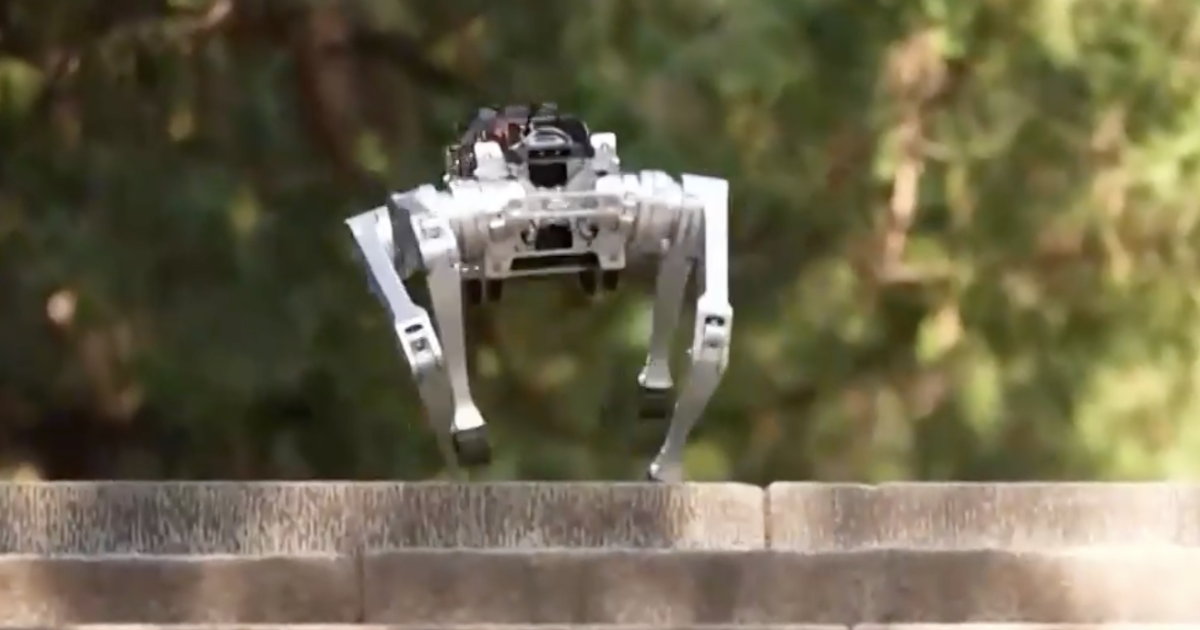
While robot dogs may seem like a thing of the past, challenging them to climb more than 3,000 uneven stone steps on a mountainside is more than just showing off what the legged machines can do. It is a great lesson in your training.
On November 2, robot dogs (and other types of machines built for some form of locomotion) participated in the first Mount Taishan World Robot Climbing Competition in Tai’an, China’s Shandong province.
According to a report in global times, Nearly 90 robot manufacturing teams flexed their engineered legs in yet another test of their skills. We’ve seen robots succeed and fail in sprint races and marathons, but conquering mountains is a new challenge.
You can watch the highlights thanks to footage courtesy of CCTV+ media.
Robots conquer a mountain in China
“Humanoid robots and robot dogs tested their climbing capabilities,” says the Times described. “They were seen climbing, stopping, recalculating, and then moving forward again with surprising agility. Some moved with careful precision, others with a quick, springy gait, giving viewers a sense of how far robotics has come and how far it still has to go in real-world scenarios.”
The route – 3.9 km, or just over 2.4 miles, with an elevation gain of around 600 m (0.37 mile) – would take the average hiker an hour or two. The best bots did it in less than 60 minutes. But just like humans, not all machine climbers conquered.
However, the one that did was a robot from Lingyi Technology of Beijing, a subsidiary of the famous Unitree Robotics of Hangzhou. The four-legged robot earned the highest speed score and completed the course in just 43 minutes and 41 seconds.
Interestingly, in testing the course, from Hongmen to Zhongtianmen, Beijing rival company UNIUBI AI put itself on the map, with its flagship robot dog Cyvet clocking a time of 35 minutes and 47 seconds. Isn’t that always the case, getting a PB time when it’s just a test or a warm-up race?
“Adapting to the road conditions of Mount Taishan was the biggest challenge,” Chen Lin, a navigation engineer with Hangzhou-based UNIUBI’s artificial intelligence team, told state media CCTV. “These stairs were built centuries ago. Some are high, some are low, some are wide, some are narrow, and there are also sections of cobblestones.”
Cyvet, the smallest robot in the competition, reportedly used LiDAR and real-time 3D mapping to master uneven terrain. So, kind of like what the human brain does when faced with such novel challenges.
Mount Taishan is the highest peak in the province and while there are several routes for hikers, some more challenging than others, the longest climb features more than 7,000 steps. However, neither route is particularly easy and you can expect to spend several hours climbing the stairs, even if you take the “simpler” route.
The four official competition events included humanoid robots running to the top, robots climbing the mountain, an exoskeleton-assisted machine, and an all-terrain exploration challenge.
Ultimately, however, the details of the event were not the focus; They were more ways to test the progress of these two- and four-legged robots that until now have done most of their movement on fairly flat terrain.
Climbing precarious and unpredictable steps really tests some important mechanics as technology develops, including balance, real-time decision making, and adaptation. These attributes will become increasingly important as robots are deployed in rescue sites and even used in less hazardous environments such as hospitality and in multi-level offices, factories and homes.
“Like early airplane and automobile exhibitions, robot sporting events can serve as visible indicators of technological maturity, attracting public attention and at the same time attracting investment,” Xiang Ligang, president of the Beijing Intelligent Era Industry Institute, said at the press conference. Times.
It’s easy to think that such events seem like a waste of time and resources, especially when they come with videos of robots falling and falling apart. But like previous athletic tests, the climb showed where engineers must improve to compete in this market.
Balance (especially for taller bipedal humanoids) will be one of the biggest hurdles for these types of robots, as will real-time decision-making without a human caregiver in tow, if we can hope to see them as reliable consumer products any time soon. And events like this are designed to accelerate the process beyond the lab.
Also, it’s worth noting that these robots, even those not at the front of the pack, deserve real credit.
If you’ve been up anywhere in China, you’ll know that even with clearly defined stone steps, it’s not like walking down a few meters from a subway station; They are sturdy but often uneven, many are centuries old, and the handrails are a pleasant but unexpected surprise. And there’s a reason escalators and elevators have become popular for taking humans to the mountains in recent years. There are even conveyor belts to transport people up steep inclines, which also makes some of China’s most beautiful sights more accessible to those of less physical ability.
Meanwhile, if you prefer the idea of riding down a mountain in style, you can now take part in real life. Mario Kart (without other drivers’ banter, of course) through Gulong Gorge, a winding 3.7 km (2.3 mile) track that takes you up and down at a top speed of 30 km/h (18 mph).
For now, we have yet to see robots master this at least.
However, the Times reported that China’s Ministry of Industry and Information Technology listed more than 400 different humanoid models in production and had released numbers exceeding 40,000 units in the first half of 2026.
Source: Global Times













Post Comment