An ‘ultrasound tube’ levitates matter from one end to the other
If the Incredible Hulk were ever unleashed into the real world, guns and bombs would stand absolutely no chance against him. According to the 2008 film, one of the few things that managed to stop the green giant were sonic cannons that immobilized it with powerful sound waves. Scientists from the University of Helsinki, in collaboration with researchers from the Public University of Navarra and the University of Michigan, have now demonstrated a glimpse of the technology behind that concept, with an ultrasonic tube that can physically confine and guide matter through the air.
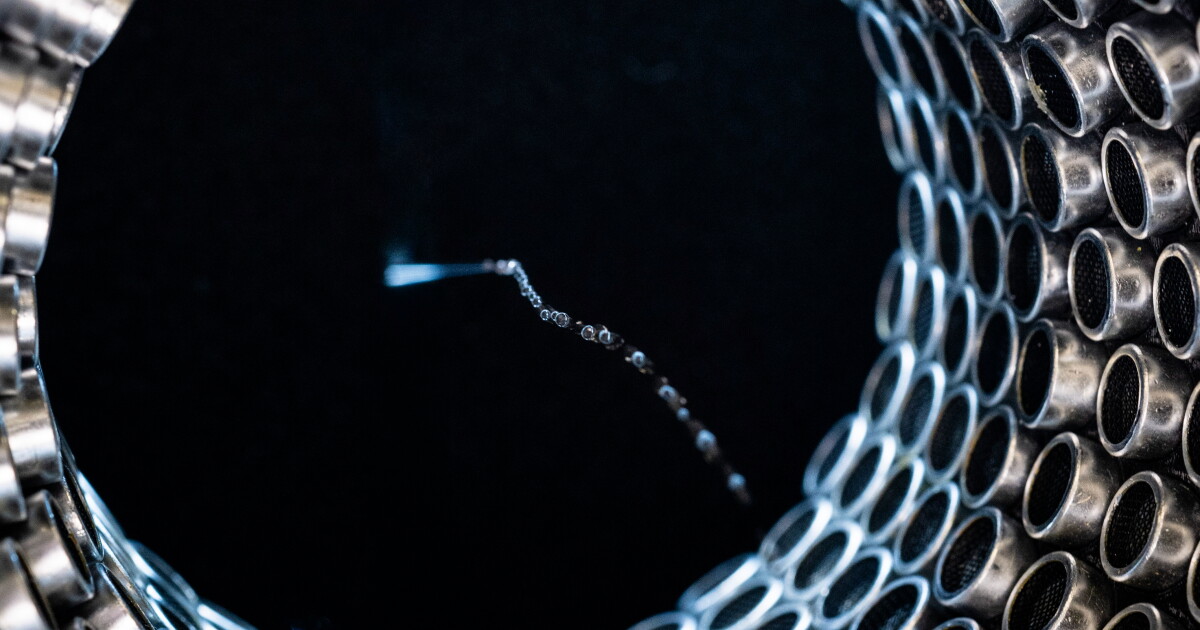
The invisible, massless tube, made solely of ultrasonic sound waves from 256 miniature speakers, can guide liquids, gases, powders and even plasma, making the substances appear to float in the air. Curiously, everything happens without any audible sound. Changing the flow direction is as simple as reshaping the invisible tube by adjusting the operation of the speakers.
“Of all the experimental setups I’ve seen, I would say this is the closest to magic,” says Ari Salmi, professor of electronics at the University of Helsinki and leader of the project.
The concept was inspired by a previous project in which researchers used ultrasound to clean substances stuck to the internal surfaces of pipes. Building on this idea, they wondered if they could eliminate the problem entirely by removing the physical walls of the pipe, so that there would be nothing to rely on in the first place.
To bring the idea to life, the researchers conducted several rounds of trial and error with different speaker configurations.
The resulting prototype uses 256 miniature ultrasonic transducers arranged around a cylindrical structure, emitting sound waves at approximately 40 kilohertz (kHz). By carefully controlling the timing of these waves, researchers can make them interact to produce an acoustic field that exerts forces on passing materials, keeping them confined to a particular path. Adjusting the field allows the team to bend or redirect that path without moving any physical pipes. The prototype tube is just 8 cm (3.1 in) long and consumes about 50 watts of electricity, about as much as an old-fashioned incandescent light bulb.
While this is just a prototype, the research shows the possibility of continuously guiding different states of matter through the air using sound alone. Previous acoustic manipulation systems had largely focused on suspending and moving individual particles or droplets, but the new system can handle continuous flows. In their experiments, the researchers successfully guided flowing water, directed powders into different containers, directed streams of fog and gas, and even controlled the path of electrical discharges.
Regarding possible applications, the equipment provides for the contactless transport of substances, in particular corrosive or sticky materials that can damage conventional pipes or accumulate on their internal surfaces. The technology could also be useful for handling highly sensitive substances that are easily contaminated. The ability to redirect flow electronically also opens up possibilities for delivering materials precisely where they are needed.
For now, however, there remains a considerable gap between this prototype and full-scale ultrasonic tubes. An obvious limitation is the size of the tube compared to what is needed to produce it. A total of 256 speakers to generate a tube that is only 8 cm long is a lot of hardware. The researchers believe they could connect similar modules in series to create much longer tubes.
Then there is the intensity of the sound. According to the researchers, the ultrasound in the center of the tube has an intensity comparable to the continuous roar of a gunshot right next to the ear. Even outside the device, the acoustic intensity is comparable to that of being next to a jet engine. Fortunately, at 40 kHz, the sound is beyond the normal range of human hearing, so you wouldn’t actually hear all that noise. Just make sure there are no dogs around.
The research was published in the journal. PNAS.
Source: University of Helsinki











Post Comment