Laser-tuned lightsaber-like plasma beam antenna
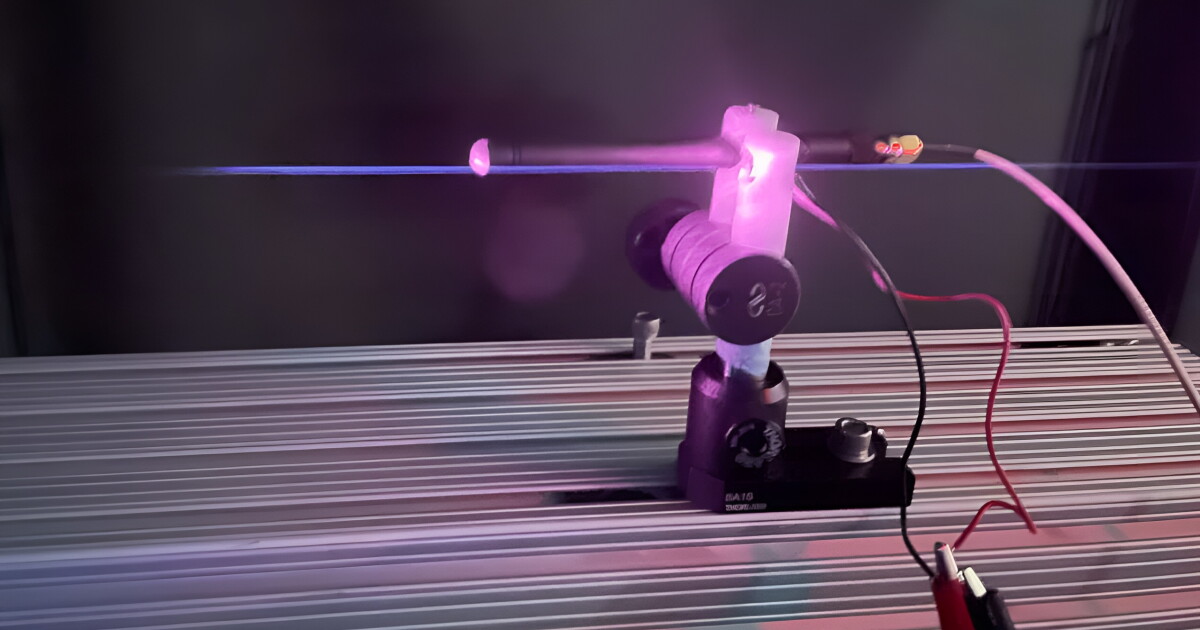
When most people imagine an antenna, they think of a thin metal rod, whether it be the thin, extendable rod of a portable FM radio or the towering structures used for radio and television broadcasting. In reality, antennas come in all shapes and sizes, from round satellite dishes to conductive patterns printed on circuit boards. However, whatever form they take, they are usually solid structures. In work that would delight any Star Wars fan, scientists have created an antenna from a plasma beam.
Researchers at North Carolina State University have demonstrated a laser-generated plasma antenna that can transmit radio waves at 30 MHz. The proof-of-concept technology could allow engineers to create antennas of different lengths and orientations simply by adjusting a laser, eliminating the need for bulky mechanical antenna deployment systems.
“The plasma beam antenna looks like a lightsaber and is tunable, meaning we should be able to transmit over a wide range of frequencies,” says Prya Darshni, a doctoral student at NC State and corresponding author of the study. He added that while the team has only demonstrated transmission, they believe the antenna should also be able to receive radio signals.
So why bother creating plasma beam antennas? A limitation of conventional antennas is that their physical dimensions, particularly length, determine the radio frequencies at which they operate efficiently. An antenna designed for one frequency could perform poorly at another substantially different frequency. Of course, we already have technologies that address this problem.
Software-defined radios (SDR), for example, can switch between frequencies without requiring hardware changes. However, the antenna itself must still be able to operate efficiently at those frequencies. Wideband, multiband, and electronically tunable antennas allow multifrequency operation, but each involves different design tradeoffs.
The challenge becomes even more pressing in applications such as space exploration, where satellites may require relatively long antennas that must be folded for launch and deployed once in orbit. Changing its physical dimensions or orientation may require additional mechanical systems, adding weight and complexity. Now, let’s imagine replacing that metal antenna with a laser-generated plume of conductive gas. Do you need a different antenna length? Adjust the laser. Do you need to change its orientation? Point the laser in another direction. These are the possibilities that researchers are exploring.
To build the device, the team used a laser with carefully controlled power and beam diameter to ionize a narrow column of air. The concentrated laser energy rips electrons from gas molecules, producing a thin shaft of plasma, known as a plasma filament, containing free electrons and positively charged ions. Because these charged particles can respond to electromagnetic fields, the filament can behave like a conventional metal antenna.
In English, the laser creates the antenna, while the plasma it produces serves as the conductive structure that transmits the radio waves. The laser beam itself does not transmit the radio signal.
Now, plasma antennas are not entirely new. Researchers have previously demonstrated antennas made of ionized gases, including laser-generated plasma columns that required additional high-voltage discharges. The NC State team has now demonstrated a different approach: a laser-generated filament and a contactless mechanism to feed it with radio frequency signals, which brings us to the second innovation.
We have a plasma antenna, but how do we connect it to the rest of the radio equipment? Conventional antennas are usually connected to transmitters through conductive metal feeds. However, connecting a metal wire directly to the delicate plasma filament would distort its structure. The researchers solved this problem by developing a contactless antenna that consists of a conductive metal ring that acts as a capacitor.
The laser passes through the ring, creating a filament of plasma that extends through its center. A radiofrequency generator then supplies the ring with an electrical signal, producing an alternating electric field that interacts with the plasma without physically touching it. This field causes the charged particles in the plasma to respond to the radio frequency signal, allowing the filament to radiate electromagnetic waves.
To test whether this setup worked, the researchers supplied a 30 MHz signal to the metal ring and placed a receiving antenna about 2 inches (5 cm) away. They first measured the received signal with the laser locked, so the capacitive feed worked without a plasma antenna. They then repeated the measurement with the laser producing the plasma filament, keeping the radiofrequency input the same.
With the plasma filament present, the received signal intensity increased by a factor of 2.5, representing a 150% improvement over the configuration without it. Both antennas were placed with matching linear polarization and measurements were performed in the near field. The results provided experimental evidence that the laser-generated plasma filament functioned as a transmitting antenna.
The possible applications of this technology go beyond ordinary radio communications. On satellites and spacecraft, engineers could, in theory, generate antennas of different lengths without needing to transport or deploy equivalent metal structures. Adjusting the direction of the laser could also change the orientation of the plasma antenna, potentially offering greater flexibility for radar systems and directional communications.
“By controlling the laser parameters, you can control the characteristics of the plasma filament, including its length,” says Darshni. “This is valuable for applications where you need an antenna that can scan all frequencies. There are also applications where it is important to be able to control the angle of the antenna to orient the direction of the radar scans or improve the strength of a signal that you want to capture,” he continues. “The technique we have demonstrated here would allow users to control the angle of the plasma filament antenna using beam steering, simply by changing the direction of the laser.”
However, there is still a considerable distance between this laboratory demonstration and a practical antenna system. Researchers have demonstrated transmission on a single frequency, 30 MHz, with the receiving antenna just 5 cm away. They have yet to demonstrate proposed frequency tuning, beam steering, radio reception or long-distance communications.
There are also questions about how much laser power would be needed to maintain a useful plasma filament, how efficiently it could transmit radio signals, and how reliably it would operate in different environments. For now, the achievement is largely a proof of concept. “This is the first step, but it’s a big step: it’s the first time anyone has shown that plasma filament antennas can work,” says Darshni. “Now that we have shown that it is possible, we can start to improve its performance.”
The study was published in the IEEE Microwave Magazine.
Source: North Carolina State University












Post Comment