Laser printer toner creates a simple touch interface

Touch screens are one of the most deceptively simple-looking technologies. A simple knock on a piece of glass can make countless things happen. In reality, touch screens involve several complex electronic and manufacturing processes. Scientists have created a new touch technology using only PVC, laser printing and regular printer toner.
Researchers at the Shibaura Institute of Technology (SIT) in Japan have developed a touch interface that can be created by printing ordinary toner patterns on a transparent PVC sheet with a conventional laser printer.
Sliding a finger across the resulting surface generates electrical signals that can reveal the direction and speed of movement, identify different patterns and letters, and even distinguish between users. The technology could offer a remarkably inexpensive and customizable alternative to conventional touch controls, especially for wearable electronics and Internet of Things devices.
According to a 2026 study, reported by Ken 5 Media, each year we swipe and tap 86 miles (138 km) of digital content. That’s the physical equivalent of commuting the entire height of the Empire State Building, from bottom to top. We’ve brought that love of tapping and swiping to everything from smartwatches and home appliances to restaurant ordering screens and industrial controls.
While they may look simple, conventional touch interfaces hide a lot beneath those seemingly simple surfaces. Capacitive touch screens, for example, use arrays of conductive electrodes and electronic components that detect changes in an electric field when a finger approaches the surface. Other touch control technologies similarly require sensors, wiring, electrodes, and a power source, along with the complex manufacturing processes that assemble everything into a finished device.
The SIT researchers’ invention aims to eliminate much of that complexity from the touch-sensitive surface itself. Its interface mainly consists of PVC and a toner patterned layer. The setup is based on triboelectricity, the same phenomenon behind the small static electric shocks you sometimes get after walking on a carpet. When two materials touch and move apart, electrons can transfer between them, leaving an electrical charge. In this case, sliding human skin over the PVC generates a measurable electrical response.
Using a common laser printer, they deposited a single layer of printer toner on the PVC sheet in specific geometric patterns. You see, toner is electrically insulating, so the printed regions effectively block direct contact between your finger and the PVC, while the uncovered regions allow it. As a finger moves alternating printed and exposed areas, the contact continually changes, producing a sequence of voltage spikes.
“The toner pattern functions as a geometric mask that controls where the skin comes into direct contact with the PVC, thus controlling the timing and polarity of the potential response,” explained study leader Hiroki Shigemune.
In other words, researchers can effectively program the electrical response by changing what they print. If the exposed sections are widened, the resulting voltage peaks will change width. They can also change the intervals between peaks by altering the spaces between them and create more peaks by adding more sections. The team says this produces a much cleaner and repeatable signal than simply rubbing a finger freely over a triboelectric surface.
Hiroki Shigemune from SIT, Japan
This opens the door to some surprisingly sophisticated contributions from an extremely simple sheet of plastic. The researchers were able to determine which direction a finger was sliding and calculate the sliding speed with an error rate of 3.5% or less. They also created binary inputs, demonstrating how the system could read a pattern representing 1010 and convert it to the decimal number 10.
Machine learning goes even further.
By analyzing the voltage waveforms, the system classified seven different printed pattern designs with an accuracy of 97.1% and recognized all 26 letters of the alphabet with an accuracy of 89.2%. In a separate user identification test involving seven participants, it also correctly identified who was using the interface 97.1% of the time. Differences in finger pressure, sliding speed, contact angle, and contact stability produced distinct electrical signatures that helped distinguish one person from another.
The durability of the setup also looks promising, at least at this early stage. After 1000 sliding cycles, surface inspection found no visible wear on the toner film, while the generated signals did not show any significant degradation. Of course, we swipe more than 2,000 times on average per day, but that’s due to much more complex technology, which brings us to the Main course of researchers’ work: simplicity.
Instead of manufacturing electrode arrays or conductive tracks and running wiring through a device, manufacturers could potentially print different interfaces using PVC, toner and cheap equipment already found in millions of offices.
“Our approach offers a low-cost, wire-free platform in which the input function can be changed simply by modifying the printed pattern,” Shigemune said.
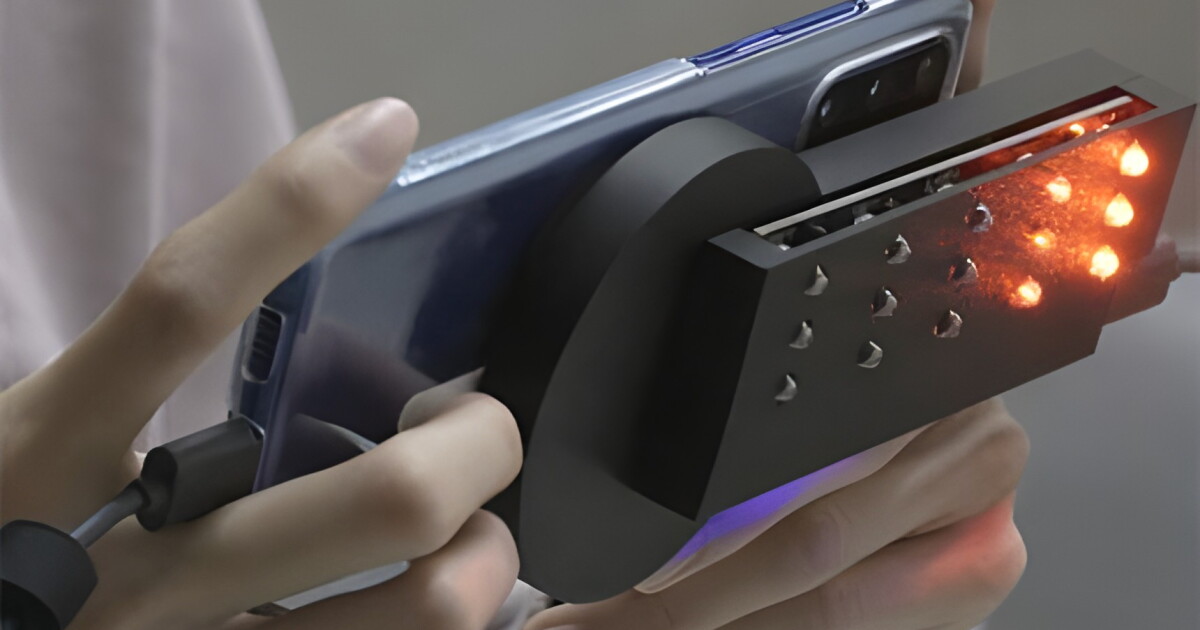
This could be particularly useful when conventional touch hardware is cumbersome or expensive, such as wearable controls, disposable interfaces, flexible wearables, simple IoT devices, keyboards, and game controllers. Instead of redesigning its sensor hardware, a manufacturer could potentially change what an interface does by changing the file sent to the printer.
However, there are some important caveats.
The main limitation is that it is not a general purpose touch screen like the one on your phone. A smartphone screen can detect a touch at almost any arbitrary point on a two-dimensional surface and determine exactly where your finger is. This interface is more like a gamepad or programmable control strip, as the printed toner pattern defines a finite set of gestures or inputs that the system can recognize.
A particular beat could mean “next,” another pattern could encode a number, and another could represent a letter. If you want the surface to produce a different set of inputs, redesign the toner pattern and print a new one. Additionally, while the PVC surface can generate its signal without an integrated electrode network or its own power supply, the system still needs electronics to collect, process and interpret that signal.
The demonstrations were also performed under controlled laboratory conditions with relatively small classification groups, including only seven people in the user identification test. It remains to be established how reliably the interface works after tens of thousands of swipes, or with dirty, sweaty or wet fingers and changes in temperature and humidity.
Still, turning a run-of-the-mill laser printer into a manufacturing tool for programmable touch surfaces is a convincingly simple idea. The study was published in the journal Nanoenergy.
Source: Shibaura Institute of Technology









Post Comment