Smartphone case device detects hidden cameras with 94% accuracy
With technology advancing every day, protecting our privacy is increasingly difficult. Hidden cameras are one of the public’s biggest concerns. There have been too many cases of people finding cameras in places they didn’t belong: hotel rooms, bedrooms, and bathrooms in Airbnb rentals. The problem became so bad that Airbnb announced a global ban on indoor security cameras a couple of years ago.
But of course saying something is illegal doesn’t magically stop people from doing it. If only there was a hidden camera detector: effective, cheap and small enough to take with you when you travel.
Well, researchers may have come up with exactly that. A team from the Korea Advanced Institute of Science and Technology (KAIST), in collaboration with the National University of Singapore and the Singapore Management University, has developed a device called SweepLED.
The basic idea behind finding a hidden camera is simple: shine a light on a suspicious object and look for the bright reflection bouncing off the camera lens. In fact, there are already devices that use this concept.
But they are not as effective…guess why? Because in every apartment or hotel room there are dozens of shiny objects: mirrors, lamps, glasses, vases, shiny plastic… and they all reflect light. Existing detectors have difficulty distinguishing between the reflection of a toaster and the reflection of a hidden camera, leading to false positives.
SweepLED is designed to address this problem. Instead of looking at a single bright spot, it analyzes how the reflection changes as the light moves, and that’s the key innovation.
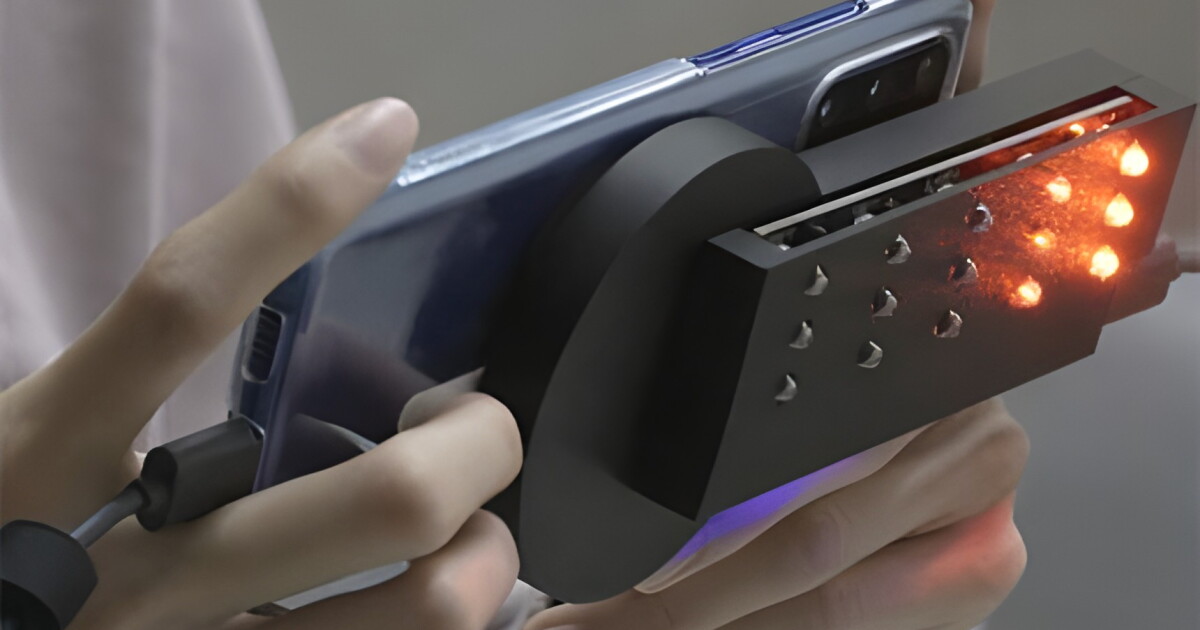
The device uses a small LED array built into the casing of a smartphone. The prototype has 15 LEDs and the hardware costs around 7 US dollars, which is a great bargain for protecting your privacy.
This is how it works…
You point the phone at a suspicious object and hold it still for a few seconds. LEDs on the back of the phone case quickly sweep light onto the object from different angles, while the phone’s camera records the reflection. Both a regular shiny object and a hidden camera lens can reflect light, but their reflections behave differently as the angle of the light changes.
And this is where things get interesting. Camera lenses have a distinctive optical structure, which produces very particular reflection patterns as the lighting changes. Those unique patterns are what the device is looking for.
kaist
The phone records the reflection changes and sends the video to software that processes and analyzes the footage. Firstly, the system stabilizes the recording, because the phone might be moving slightly. It then compares the frames captured with the LEDs on and off to isolate reflections produced by the LED sweep.
The researchers use a trained AI model to track and analyze the captured changes over time instead of simply looking at a single image. Basically, instead of pointing out all the shiny things, look for those whose reflection changes in a particular way.
The prototype was tested on 30 different objects, including those with built-in cameras and common household items. According to the researchers, the system achieved approximately 94% detection accuracy and took about five seconds to inspect each object.
For now, SweepLED remains a prototype, but with promising test results and hardware that costs about the same as a cup of coffee, it has a good chance of becoming a great privacy tool in the near future.
A paper on the technology was presented at ACM MobiSys 2026.
Source: KAIST












Post Comment