A small drone borrows an unexpected feature from nature
Thanks to their highly sensitive whiskers, which allow them to detect objects within their reach before they get too close, rats and mice can hardly identify with the pain of a stubbed finger, despite having eight more fingers than humans. This sensory organ allows rats to scamper through buildings, sewers, burrows, and many other environments with ease, regardless of visibility. Beyond touch, whiskers can also detect vibrations and even subtle air currents.
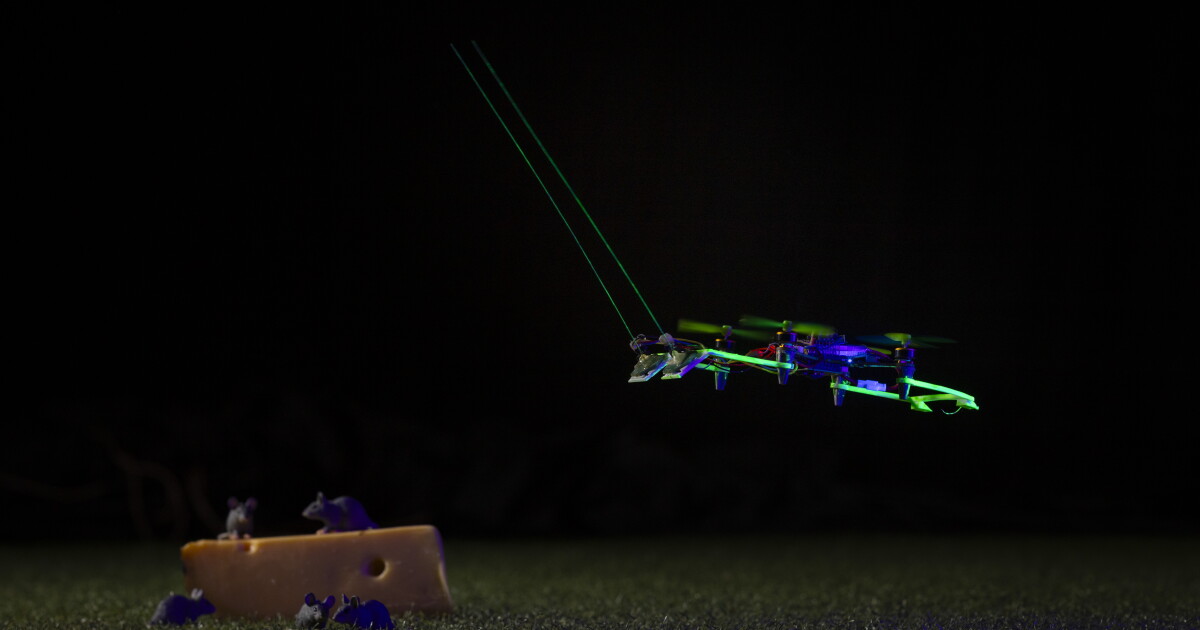
Inspired by this tactile sensation, researchers at Delft University of Technology in the Netherlands have developed what they describe as a lightweight, whisker-based tactile sensor that provides drones with the ability to navigate and explore their environment through gentle touch. Made from nitinol wire, an ultra-lightweight nickel-titanium alloy with shape memory, whiskers allow drones to sense their surroundings through touch rather than sight, allowing them to operate in the dark and in low visibility conditions.
Now, today’s drones don’t crash into random objects. Modern autonomous drones are highly sophisticated equipment with advanced navigation and object avoidance systems that ensure they almost never encounter obstacles. The problem, however, is with the tiny autonomous drones. Below 100 grams, it is much more difficult to balance weight limitations with the performance these systems offer. Conventional cameras, LiDAR and other navigation sensors are often too heavy to be integrated into such aircraft.
To address this challenge, the researchers created lightweight, pressure-sensitive artificial whiskers, each weighing just 3.2 grams and measuring 200 mm long. They integrated two whiskers into the front of the drone. At the base of each filament are three miniature barometric pressure sensors connected to an integrated microcontroller. When the drone flies near an object and a whisker brushes or bends against a surface, pressure changes at the base are measured in less than two milliseconds, allowing the drone to calculate contact location and depth with millimeter precision.
Delft University of Technology – Studio Oostrum
“Here, our goal is to equip drones with a rich tactile sensation, not for mid-air manipulation, but for a novel concept of tactile navigation: using touch to explore and fly through the unknown. But this comes with a challenge: for tactile sensing to work in drones, it must be lightweight, low-latency and low-power. Inspired by nature, we found the answer in whiskers,” explains Salua Hamaza, associate professor of Air Physical Interaction and Body Intelligence in Aeronautics. Robots at Delft University of Technology.
Now, you might be wondering how a highly sensitive pressure sensor connected to a pressure-generating component, like a drone, vibrating and producing a noisy airflow would work. The researchers thought about this too. They developed a lightweight real-time processing system that uses advanced onboard software to distinguish meaningful tactile information from turbulence generated by the drone’s own propellers, extracting reliable tactile information. only during the flight. Surprisingly, the system does this with only 34 kilobytes of data.
“We wanted to demonstrate that touch doesn’t have to come at the expense of size or computational power. Our entire tactile perception system works on board using just 34 kilobytes of memory, allowing a small drone to detect and respond to its environment in real time,” said project participant Chaoxiang Ye.
Small drones that perceive the world through touch
In the experiments, the whisker-equipped drone not only followed surface contours in complete darkness and explored enclosed spaces by following walls, but also constructed tactile maps of unknown environments and located exits without relying on vision-based sensors. These capabilities are very useful in search and rescue scenarios where darkness, smoke, dust and other particles can limit vision-based navigation.
An important caveat here is that whiskers need to touch an object to know it’s there. Considering that the whiskers are only 200mm long, this means that the drones cannot travel over unmapped terrain at high speeds. Your momentum will smash you directly into the obstacle before the whiskers even detect it’s there.
Additionally, the whiskers are in front, which prevents the drone from detecting side obstacles, such as random jagged branches in a forest. The system is designed specifically for structured, low-visibility tunnels, and excels in environments with continuous, relatively flat surfaces, where the drone can press its whiskers against a wall and follow it like a visually impaired person using a cane.
The study was published in the journal Nature Communications.
Source: Delft University of Technology












Post Comment