Build your own 4G smartphone with the CircuitMess MAKERphone 2.0 kit
The promotional video for the new MAKERphone 2.0 kit from CircuitMess points out that today, smartphone users are dependent on their mobile phones and at the same time feel alienated from them. According to CircuitMess, this is because we don’t understand how smartphones work, since most of us can’t repair them or even see their components. So how would our relationship with them change if we built them ourselves?
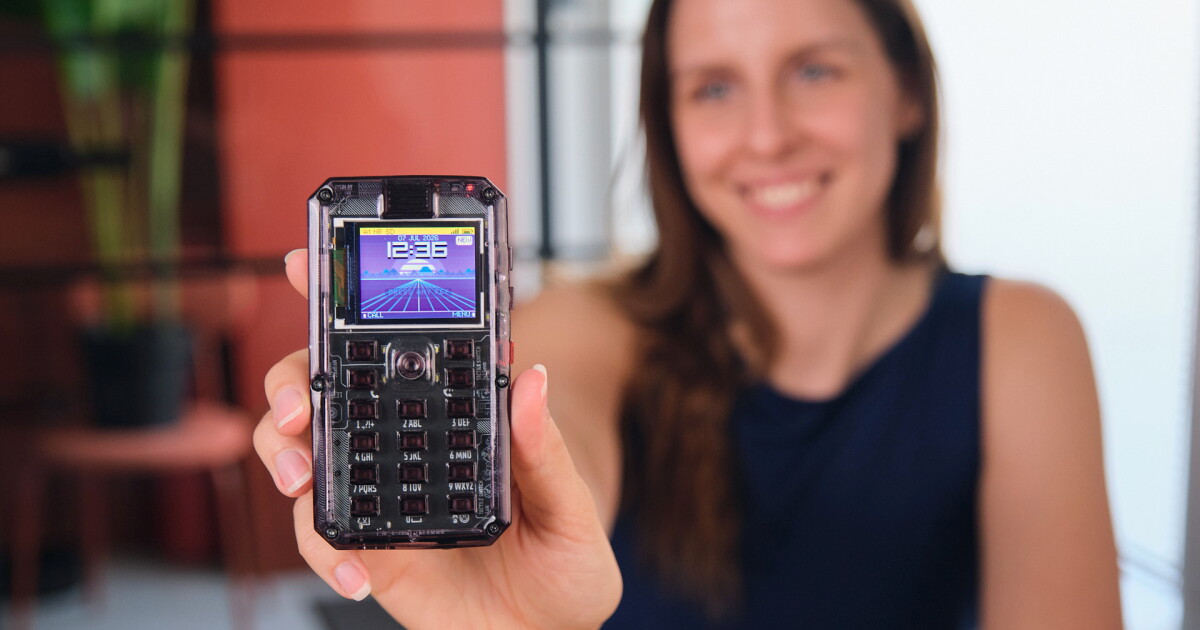
Assuming all of CircuitMess’ claims are correct, its new MAKERphone 2.0 will be a DIY kit that will allow users to assemble a fully functional 4G phone for voice calling, text messaging, and alarm apps, calendars, music, pictures, note taking, and ringtones, all starting at $129. It is currently the subject of a Kickstarter campaign.
Circuit
The MAKERphone 2.0 features a 1.77-inch, 160 x 128 pixel color display, which is still big enough for a simple game (the unit includes “5+ retro games”; does that mean six games? And what games?). Its 2=ABC, 3=DEF mechanical numeric keypad will provide joyful texting for many (and a terrible annoyance for others). Because the unit can’t run social media apps, it’s ideal for people who need to be able to communicate with loved ones and co-workers without the soul-sucking, productivity-destroying distraction of the Zuckerverse.
You won’t need any special tools or a soldering gun to assemble MAKERphone 2.0. Unlike MAKERphone 1.0, which required seven hours of soldering, MAKERPHONE 2.0 does not require any soldering. It is a two-hour assembly kit that allows users to customize the unit with optional components (such as cameras, speakers, flashlights, infrared TV remote control, and motion, temperature and humidity sensors) for new functions.
Circuit
Beyond the Lego-style assembleable construction mode, MAKERphone invites comparison with Lego Mindstorms robots, because the device comes with its own VibeBoy Claude LLM coding “studio.” VibeBoy allows users to describe a desired function so that the LLM can generate code to fulfill it, code that subscribers can view, edit and improve. If users want an LLM to learn programming, CircuitMess offers subscription-based VibeBoy Pro (first three months are free). But for those who prefer a life without LLM, the user can program the unit with MicroPython and Arduino C++.
In addition to an ESP3-33 processor, the MAKERphone features dual-core, Wi-Fi, Bluetooth, 4MB of flash memory and 4MB of PSRAM, with a standard headphone jack, a 1000mAh battery, a USB-C port for charging and connecting a computer, a microSD card slot, and a UMAX port for connecting modules.
Circuit
A particularly attractive feature of the new device is the Pro Module Pack. Offers smartphone-to-smartphone text messaging without the need for a SIM card, Wi-Fi or cell towers; a banana clip 12-touch tab for lo-fi improvised musical instruments (e.g. a drum kit that uses spoons); an e-paper/zero electricity display; and a laser pointer. The Pro Module Pack also includes standard items such as a GPS unit, gyroscope, and vibration motor.
Kickstarter pledges start at $129 (expected retail: $169) for a bundle that includes the phone kit and three months of the VibeBoy Pro. A pledge of $189 (retail $258) also includes a MAKERband, the DIY smartwatch companion to MAKERphone 2.0 that CircuitMess promises will allow users to expand the usefulness of MAKERphone.
MAKERphone 2.0 – a DIY educational mobile phone
Source: Kickstarter
Note: New Atlas may earn commissions on purchases made through links.










Post Comment