I can’t stop looking at the MacBook Pro’s touchscreen and now I know why: it’s a technological unicorn
follow us
Add us as a preferred source on Google
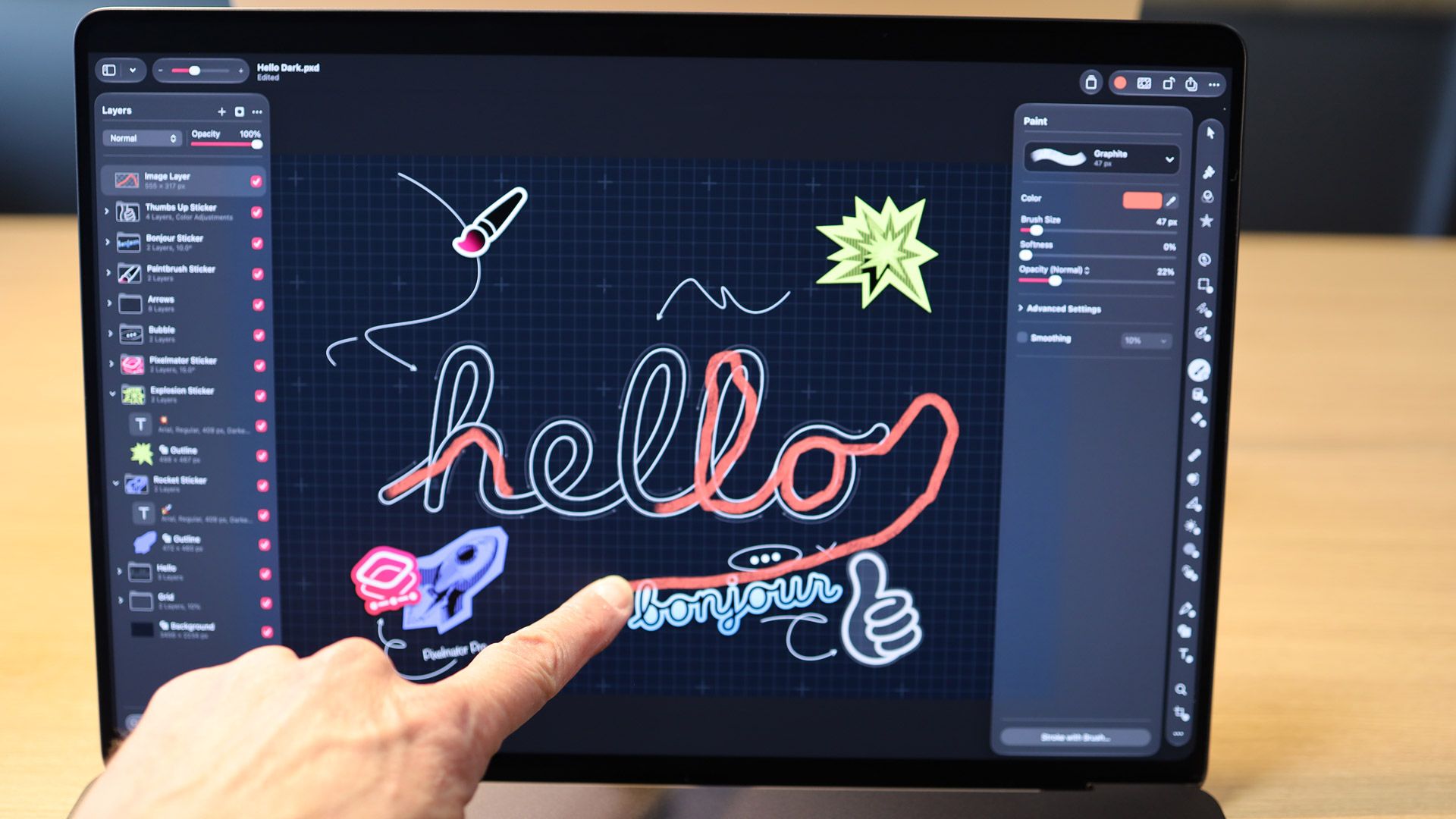
Now that I’ve seen and touched the touchscreen MacBook Pro, I’m starting to understand that, despite the invention of a new Frankenstein-esque display term (‘PROLED’?), this display could be something special. It looks extraordinary and, in visual comparison with, say, the Lenovo Yoga Pro 9i Aura Edition, which also has a Tandem OLED, it doesn’t even seem to be the same species.
There are good reasons for this, ranging from the manufacturing process to the basic specifications of what is clearly Apple’s most advanced laptop display yet.
Starting with manufacturing, Apple says it employed an unnamed manufacturing partner to build these panels in what is known as the Gen-8 OLED Fab. Given that there are only four of these state-of-the-art facilities in the world, and that one of them is operated by Samsung Display, which has supposedly previously partnered with Apple on display technology, I’m assuming it’s Samsung.
Latest videos ofTechnologyRadar
One of the most notable features of these manufacturing facilities is their enormous size. Whoever the partner, we know that the touchscreen MacBook Pro panels are manufactured in a chamber about the size of the Colosseum in Rome. These massive facilities improve performance, efficiency and costs.
Although less than a millimeter thick, the laptop’s PROLED XDR panel is made up of 50 layers. Even what appear to be individual panels have many layers, sometimes just a nanometer thick. The two OLED stacks have, for example, 30 layers, although the self-emissive organic material is placed on the panels and dried, making the layers between one nanometer and hundreds of nanometers thick. FWIW, I’ve held a few of these individual panels and they are incredibly thin and light.
Behind the OLED is the TFT (thin film transistor) glass substrate that powers and controls the images on the surface.
What’s not mentioned here is the digitization layer (basically the same touch technology found in the iPhone and iPad) that powers touch; that’s because it’s integrated with the whole in a process that, if it isn’t already, should probably be patented.
Despite working with a third party, production is another custom Apple-branded process, and not necessarily replicated in other tandem OLED display manufacturing processes or even basic OLED display processes.
The specifications confirm it. While the Lenovo Yoga Pro 9i Aura Edition touchscreen has a nice 1,000,000:1 contrast ratio, Apple’s touchscreen MacBook Pro boasts 10,000,000:1. In person, and even in bright conditions, the blacks and definition I saw on the MacBook Pro PROLED XDR touchscreen are impressive.
The MacBook Pro’s display also looks better because Apple equipped it with up to 2,000 nits for HDR and SDR content, as well as an anti-glare display and the nano-etching option. Basically, I could see my reflection in the Lenovo and couldn’t detect my reflection in the MacBook Pro.
Additionally, for those concerned about fingerprints building up on the MacBook Pro’s touchscreen, Apple has applied an oleophobic coating to the standard and etched screens. In my hands-on time with several of the new laptops, I didn’t notice any significant fingerprints.
Compared to the 1,600 nits of the Lenovo Yoga Pro 9i, the touchscreen MacBook Pro seems better equipped to work in direct sunlight. From what I saw, the MacBook Pro also maintains much better off-axis color quality.
Beyond direct visual comparisons to professional-grade Windows laptops, Apple is positioning the MacBook Pro’s touchscreen as a color reference display and one that has supposedly sufficient grayscale accuracy for medical diagnoses. This is basically a reference monitor in a laptop frame.
So, sure, the story is that we finally have a MacBook with a touchscreen, but it may be the visual quality that finally convinces creative, business, medical and film professionals. It’s probably the best display Apple has ever produced, not just for a laptop, but possibly for any Mac system.
Of course, a screen panel alone doesn’t make a laptop, and there are questions about whether everyone wants or needs touch, whether the redesigned hinge is stable enough to keep the laptop from wobbling with each touch, and whether the touch capability is worth the nearly $1,000 premium.
Follow TechRadar on Google News and add us as a preferred source to receive news, reviews and opinions from our experts in your feeds.










Post Comment