‘Invisible ink’ keeps tattoos hidden until they are under certain light
Tattoos, once the hallmark of cyclists, sailors and commoners in general, have become much more common, decorating the bodies of everyone from teachers to lawyers and world-class surgeons.
However, being a 24/7 art gallery may not be everyone’s cup of tea. But the new inks could add a degree of transience to tattoos, making them more like summer fashion trends than permanent features.
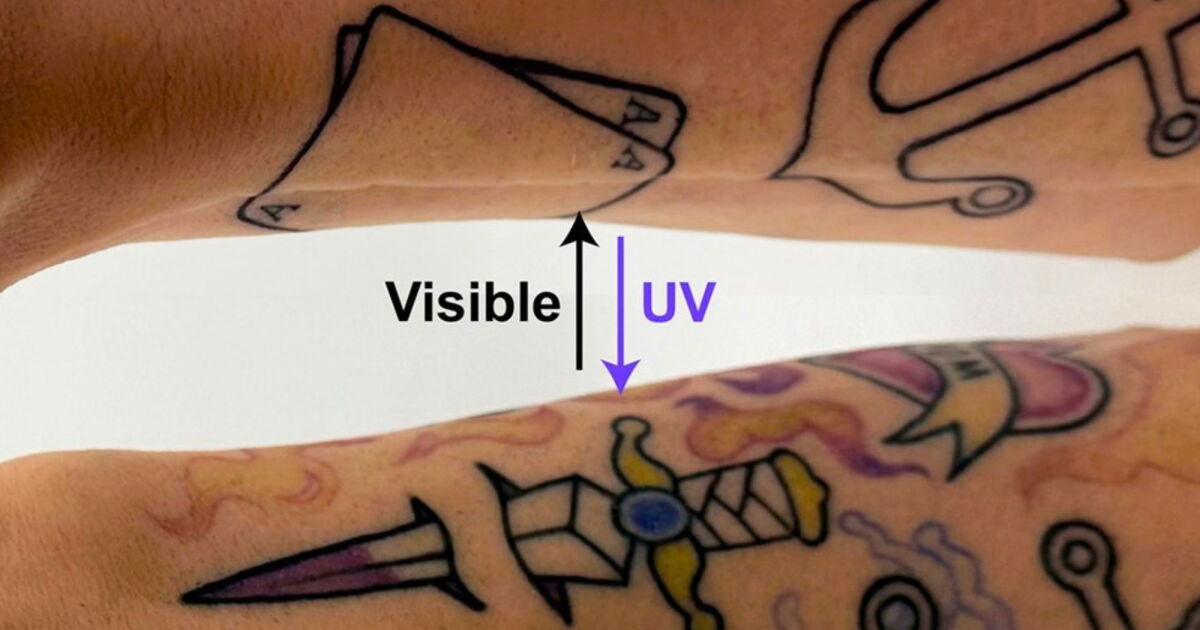
Called PhotoTat, the inks can be switched between nearly invisible and brightly colored states using different types of light. In the future, that could mean hiding a tattoo at a business meeting, revealing it later, or even rewriting what’s on your skin.
A team of researchers led by chemist Carson Bruns at the University of Colorado at Boulder developed three light-sensitive dyes that are encapsulated in small particles of polymethyl methacrylate (PMMA), a transparent plastic better known as plexiglass.
Under normal visible light, the dyes are almost invisible. However, when illuminated with 365 nanometer ultraviolet light, they light up quickly and produce vivid blue, magenta and yellow colors.
The three colors can be combined to produce different shades and patterns. Once UV light is removed, colors gradually fade over hours, although bright visible light can make them fade faster.
In other words, the same tattooed skin could show different images at different times.
“PhotoTat is like a switch. You turn it on with UV light, but you can turn it off again when you go to grandma’s house,” says Bruns.
The researchers demonstrated this by using patterned UV light, stencils, and projected images to write designs on PhotoTat. In tests using silicone and excised pig skin, they produced multicolored images, as well as tattoos that were almost invisible under normal light but appeared when illuminated with ultraviolet light.
The technology could have applications beyond simply giving tattooed people a more flexible wardrobe.
One possibility is radiation therapy. Patients can receive small permanent tattoos to help doctors align the radiation beams with the correct part of the body. PhotoTat could potentially allow those marks to remain hidden until they are needed in a clinic, reducing the psychological burden of having a permanent reminder of treatment.
“They are not beautiful and become a permanent reminder of a traumatic experience,” says Bruns.
“With PhotoTat, we could turn an involuntary medical tattoo into something that is only visible to the doctor when you go to the clinic, and then it can be invisible the rest of the time.”
The researchers also demonstrated a similar approach to marking biopsy sites, where the marks become visible when activated.
There is some evidence that the basic technology can persist in living human skin. In a single human participant, all three PhotoTat color channels continued to respond to light and were able to rewrite themselves between 1.4 and 2.2 years after tattooing.
But there’s still a long way to go until programmable tattoos are available at your local salon.
The human experiment involved a single participant, while multicolored tattoos with full designs were demonstrated on silicone and pigskin. The researchers also found that the tattoos became less visible as skin pigmentation increased, although they remained noticeable on the darkest-skinned model tested.
(Brun et al., Matter and Light2026)
And although PMMA and related photochromic materials have a history of medical use, specific PhotoTat formulations still need independent testing for toxicity, sterility and purity before they are considered for widespread use.
There is another practical problem: sunlight contains UV rays. Outdoors, inks can gradually transition to an intermediate state, meaning keeping them completely hidden would require UV protection, such as sunscreen.
Still, the idea changes the nature of a tattoo in a fairly fundamental way.
Instead of choosing an image that you are prepared to wear for the rest of your life, you could eventually choose what you want your skin to show today.
This research was published in the journal Matter and Light.
Source: SciMex













Post Comment