Battery-free smart glasses monitor your health through flashing energy
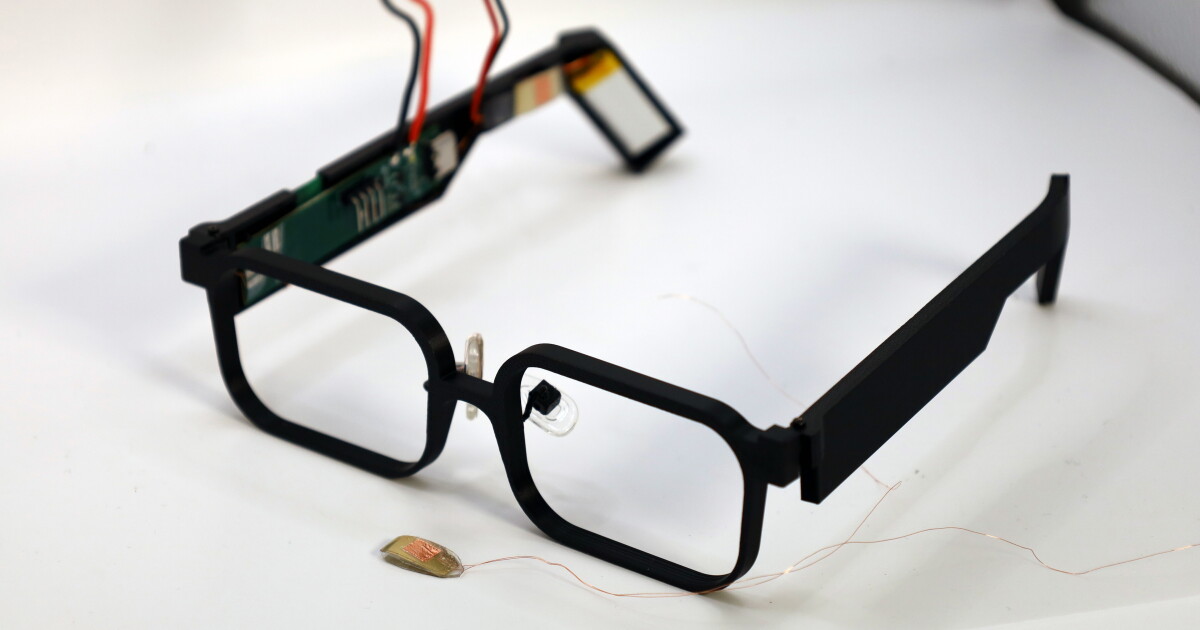
Your eyes blink approximately 14 to 20 times per minute, and each of those movements is a waste of energy. Engineers at Northwestern University have found a way to put that motion energy to work, powering a pair of health-sensing glasses without batteries.
Almost half of us on this planet wear glasses. Therefore, leveraging a technology that is already used by more than 4 billion people to collect health data would be a good way to kill two birds with one stone. Add in the fact that there’s no battery to charge or replace once it wears out, and you’re looking at the near-perfect portable device.
“The human face is a gold mine for health data, making everyday glasses perfect for wearing,” said Northwestern’s Nivedita Arora, who led the work. “Usually, wearable devices track health data, such as heart rate, through the wrist. But people need to remember to wear those trackers and take them off to recharge them. Our idea is based on the fact that half of the population already wears glasses. We can turn those glasses into wearable devices without asking people to change their habits and behaviors.”
Northwestern University
The prototype is called GlassTENG and harnesses not only the energy of blinking but also the energy of smiling, clenching the jaw, and raising the eyebrows. Its sensors read those movements, along with your pulse, to track conditions including bruxism (teeth grinding), fatigue and cardiovascular health.
To do this, the researchers used sensors called triboelectric nanogenerators, or TENGs, which are thin devices that collect static electricity, the same energy that makes a balloon stick to your hair. When two different materials (in this case the sensors and the users face each other) touch and then move apart, they can exchange electrons and produce a brief electrical charge. GlassTENG’s flexible sensors contain layers that press together and separate as the face moves. Arora explained that this same movement provides the mechanical energy necessary to drive its detection.
The team mounted three sensors on the frame. One sits on the bridge of the nose, next to the angular artery, and listens to the pulse, the blinking, and the movement of the eyebrows. A second rests at the temple, above the superficial temporal artery, and tracks pulse and jaw activity. The third is located closer to the ear and detects chewing and clenching of the teeth.
Each action leaves a different electrical footprint. The pulse, the weakest signal tested, produced 50 to 100 millivolts. Blinking and eyebrow raising produced between 200 and 500 millivolts, and strong jaw movements reached up to 1.5 volts.
Northwestern University
To test the results, a machine learning algorithm trained to learn to recognize patterns from examples analyzed signals from 20 volunteers. The researchers report an overall accuracy of 93.8% in identifying what each person was doing. Teeth clicking was recognized 99% of the time and jaw clenching 96% of the time. Pulse was checked separately with 10 participants who were sitting and resting. Compared to a reference chest strap, the goggles were deflected by an average of 1.82 beats per minute.
The system is not perfect yet. Chat over dinner and glasses may assume your mouth is busy with the main course. Talking was correctly identified only 55% of the time and was confused with eating in 37% of the cases. The authors attribute this to both activities moving the jaw and activating the temporalis muscle (a muscle on the side of the head) in a similar way.
For now, GlassTENG sends its data via Bluetooth to a smartphone or tablet, but the team wants to cut that tether. “In the long term, we want to perform calculations on the device,” Arora said. “If it detected a physiological event, it could have intelligence in the battery-free device that could provide immediate feedback. For example, if it detected jaw clenching, it could immediately alert the user to relax their jaw. I think it’s just a matter of time until the glasses we wear every day can monitor our health.”
The work will be presented this week at the UbiComp/ISWC 2026 symposium in Shanghai.
Source: Northwestern University








Post Comment