Bird-inspired drone uses touch to grab tree branches
Countless fields, from military operations to environmental research, rely heavily on drones. Executing a safe landing remains one of the biggest challenges, especially when conditions are far from perfect.
Researchers have already found some pretty creative solutions. Learning from the animal world, they developed drones that can land on steep, icy surfaces using technology inspired by cat claws, or that slow down to land by spreading wing membranes inspired by those of flying squirrels. But landing on tree branches is even more complex, so it remains an unsolved challenge.
So wouldn’t it be easier to keep the drone floating in the air? Well, sometimes that’s exactly what researchers need, but other times it can get in the way, mainly for two reasons: Hovering drains the battery pretty quickly and produces a constant, noticeable noise. When it comes to observing wildlife, researchers need something more like a spy camera: discreet and quiet enough that animals and birds won’t be spooked.
Some drones already use claw-like pincers to cling to tree branches. But holding on to a branch is only half the challenge. The drone also needs to know exactly where the branch is, and that’s where things get complicated.
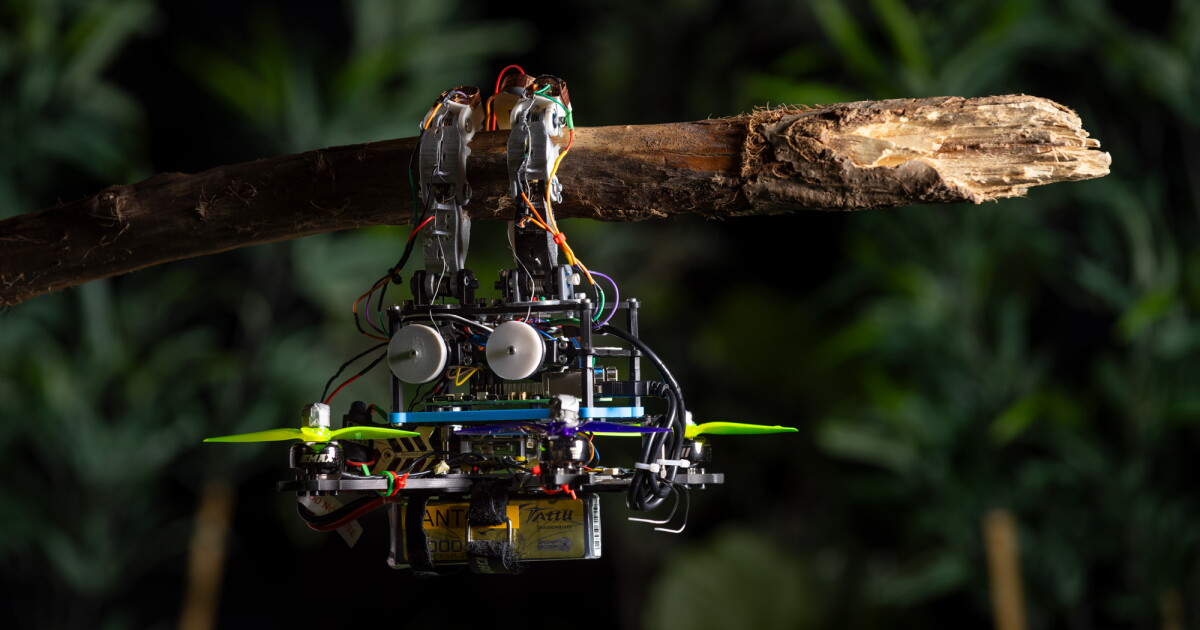
When landing, drones often rely on cameras to determine where and how to land. But in a forest, branches and leaves can obstruct the camera’s view. That’s why researchers at Delft University of Technology (TU Delft) in the Netherlands took a different approach: what if a drone could use touch sensors instead of relying solely on its cameras? They were inspired by birds, which use their feet to feel a branch before landing on it.
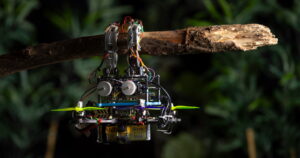
Delft University of Technology – Studio Oostrum
The new prototype features three flexible “fingers,” each made up of three sections (or phalanges), like a human finger. This design provides flexibility to wrap a branch and also creates a larger contact area.
At first, the drone still uses its camera to estimate the location of the branch. But then, instead of completely trusting the camera, he reaches for the branch with his “fingers” and literally begins to feel it until physical contact is made.
Each finger has three touch sensors on its soft silicone surface. Once one of the sensors touches the branch, it sends an electrical signal to the drone, essentially providing a simple yes or no answer to the question: “Am I touching the object?”
Because the drone knows which of its nine sensors have been activated, it can improve the estimation of the location, size and position of the branch. It is very similar to trying to find and recognize an object with your hands while keeping your eyes closed.
Animated image of touching hand.
“Each sensor only tells us ‘there is something here’. But if you know the shape of your own hand, that is enough to reconstruct where the branch is and how it is oriented. The drone creates an increasingly precise ‘image’ of the target simply by crashing into it,” explains Anton Bredenbeck, one of the authors of the project.
Once contact is made, the drone adjusts its grip, wrapping its fingers around the branch, locking them, and holding its position securely. Holding on to the branch does not consume additional energy thanks to special springs built into the fingers.
Testing of the system yielded impressive results: the drone achieved a landing success rate of more than 99%. Even when its initial visual estimate of the branch location was off by up to 60 cm (approximately 24 inches), the drone was still able to correct itself and complete a safe landing.
Delft University of Technology – Studio Oostrum
The ultimate goal of the project is not to completely replace cameras when landing drones, but to supplement them with touch sensors, especially when conditions are challenging and visual information is less reliable.
An article about the study, led by Assoc. Prof. Salua Hamaza, was recently published in the journal Nature npj robotics.
Source: Delft Technical University



Post Comment