Video: Drone with cat claws is the first to land on almost vertical ice walls
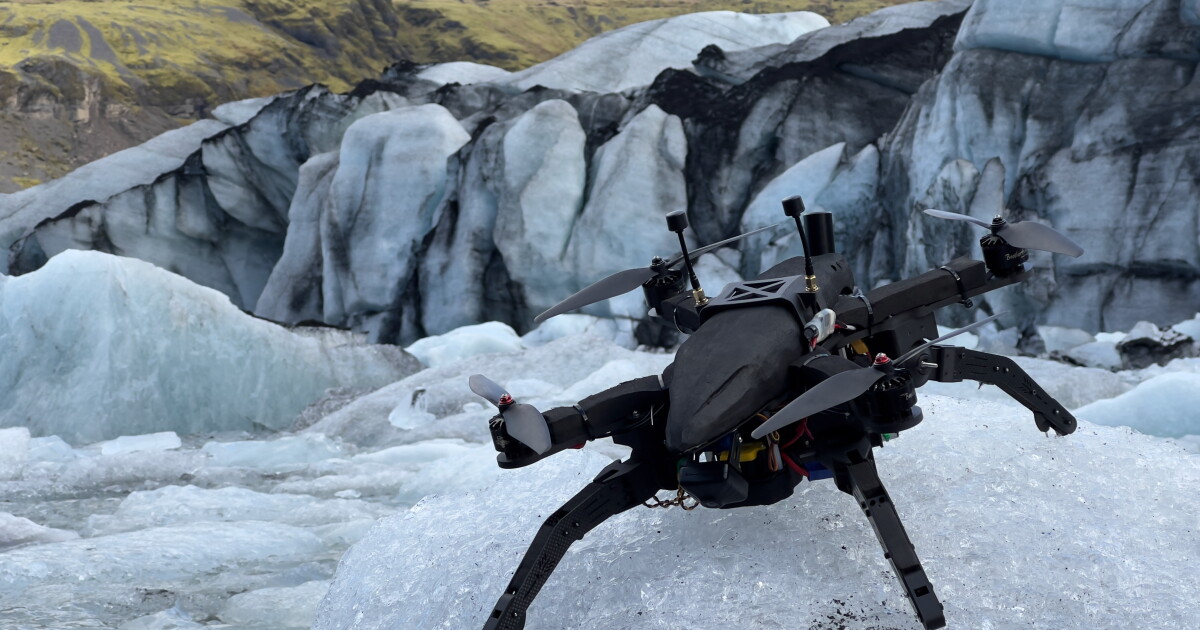
The Ice Dart is a quadcopter designed by researchers at the University of Sherbrooke in Quebec to solve a problem that has quietly limited drone science for years: there is almost nowhere safe to land in the most hostile environments on Earth.
Ice is especially bad. Standard rubber-footed drones start to lose grip on slopes as gentle as 9 degrees, and the steeper the slope becomes, the less weight of the drone itself presses it against the surface; On a 60-degree wall, gravity only immobilizes the plane with half its usual force. The Ice Dart solves that problem and becomes, according to the team’s new article, IEEE Transactions on Field Robotics – the first drone capable of landing on such steep ice and maintaining its position.
The Ice Dart belongs to a broader push in robotics called perching, an approach borrowed from nature that attempts to give drones the ability to cling to surfaces like birds, insects and geckos do. Instead of burning through its battery to hover indefinitely, a perched drone lands, turns off its noisiest systems, and becomes a stationary sensor for as long as needed. Researchers have built versions that cling to tree branches, cling to rough walls, and even cling to moving vehicles, but ice (especially steep, unpredictable glacial ice) remained one of the toughest obstacles in the field.
We landed a drone on STEEP ICEBERGS using retractable claws!
“The inspiration for the retractable spines on the feet came from observing a cat’s claws and their ability to deploy only when necessary,” says Isaac Tunney, a postdoctoral researcher in mechanical engineering and robotics at the University of Sherbrooke and first author of the study. “I wanted to create feet that would naturally and passively engage their spines in the ice at the right moment, regardless of the drone’s orientation, surface geometry, or ice conditions.”
The trick to achieving this lies in three technologies working together. Each of the drone’s four carbon fiber legs, arranged in an He lands uphill and a column snags; It lands downhill and the other does the job without requiring a pilot to calculate the perfect approach angle.
The second piece is a shock-absorbing landing gear: 38 friction discs that absorb the force of the impact so the drone doesn’t bounce. A rebound would be fatal to the plan, since the thorns only bite if the legs are compressed against the ice. The third trick is more of a magic move: For a split second upon contact, the motors briefly reverse thrust, physically pushing the drone against the wall to help the thorns dig in, which is more important on steeper slopes where gravity alone isn’t enough.
University of Sherbrooke
The team tested the drone in real-life conditions, flying the Ice Dart along Iceland’s Fjallsjökull glacier, in temperatures between 0 and 10°C (32 to 50°F) and winds exceeding 30 km/h (18.6 mph). It made 24 clean landings on slopes up to 58 degrees, with a 100% success rate even in wind. In more controlled laboratory tests, it achieved slopes of up to 60 degrees at landing speeds of 3 m/s (6.7 mph).
That capability opens the door to a genuinely new type of Arctic surveillance.
A hovering drone drains its battery in minutes, but a perched one can sit still for hours or days, acting as a stationary sensor rather than a fuel-guzzling flying device. This is useful, the study’s authors note, for everything from iceberg monitoring and maritime safety to environmental research and broader Arctic monitoring, in a region where ship traffic and offshore operations continue to move north. A drifting iceberg can pose a serious threat to oil platforms and shipping lanes, and until now, keeping a close eye on one has been costly and limited; It’s usually a matter of dropping instruments from a helicopter or ship and hoping they land somewhere useful.
“The ability to land instead of hover can fundamentally change the way drones are used in the field,” says Alexis Lussier Desbiens, professor of engineering at the University of Sherbrooke and co-author of the study. “Once a drone has landed, power consumption drops dramatically, allowing for much longer observation periods with a small aircraft. The drone also becomes completely silent and can even reduce or eliminate its thermal and RF signature by turning off the main onboard systems.”
Testing in Iceland still relied on a human pilot supported by a second drone for visual inspection, not full autonomy, and the Ice Dart has not yet been tested on a genuinely drifting iceberg bobbing in open water, arguably the scenario in which it would prove most useful. Closing that gap and developing autonomous landing is the team’s next logical step before the Ice Dart goes from a promising field prototype to a functional Arctic monitoring tool.
Source: IEEE Xplore via IEEE Spectrum












Post Comment